
The Day After the Ayatollahs

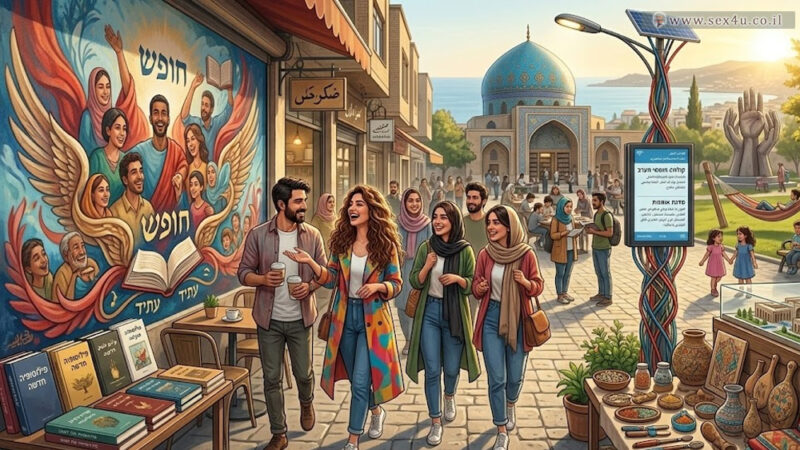
What the Middle East Might Look Like if Iran’s Theocracy Falls – and What Happens if Israel and Iran Become Partners
For decades, one idea sounded almost absurd.


An Israeli–Iranian alliance.
For forty years we have grown used to thinking about Iran through a very specific set of images: clerics in black turbans, missile parades, ideological speeches, and a long list of proxy militias funded by Tehran.
But the Middle East has a peculiar habit of forgetting small historical details.
And here is one of them:
The hostility between Israel and Iran is not historical. It is political.
Before 1979 the two countries were not enemies. In many ways they were natural partners.
After 1979 they became ideological adversaries.
Which means that if the Iranian regime ever collapses, the consequences would go far beyond a domestic revolution.
It would be a geopolitical earthquake.
And if you think the Middle East is already confusing enough, wait until the day Israel and Iran might find themselves on the same side of the map.
A Brief History Lesson the Region Likes to Forget
Before the Islamic Revolution, under the rule of
Mohammad Reza Pahlavi,
Iran was one of Israel’s most important regional partners.
The relationship included:
- Intelligence cooperation
- Oil trade
- Military coordination
- Economic partnerships
At a time when most of the region treated Israel as an enemy, Iran was one of the few countries that did not.
Then came 1979.
The revolution led by
Ruhollah Khomeini
replaced geopolitical pragmatism with revolutionary ideology.
From that moment on, Israel was no longer merely a regional rival.
It became a symbolic enemy in the ideological narrative of the Islamic Republic.
But what happens if that regime disappears?
This is not science fiction.
Iran has been dealing for years with:
- a struggling economy
- widespread protests
- internal power struggles
- a young population increasingly hostile to theocratic rule
If the regime collapses, the key question will not be whether change comes.
The question will be who fills the vacuum.
Scenario One: A Secular, Pragmatic Iran
This is the scenario Western analysts like to imagine.
Iran returns to a more traditional model of statehood: pragmatic, national, and primarily concerned with economic growth.
Not a Scandinavian democracy – but something far less ideological.
In such a scenario Iran would likely prioritize:
- economic recovery
- energy exports
- regional stability
The main geopolitical rival would not be Israel.
It would likely be Turkey and Saudi Arabia, both of which compete for regional influence.
Scenario Two: The Regime Survives – But Changes
Another possibility is not collapse but evolution.
The Islamic Republic might survive while gradually abandoning its revolutionary ideology.
Think less revolutionary Iran, more pragmatic authoritarianism – something closer to the model seen in other centralized states.
In that case Iran might reduce its commitment to exporting revolution and supporting militant proxies.
Israel and Iran would not suddenly become friends.
But they might stop being enemies.
In the Middle East, that is often close enough.
Scenario Three: Iran Fractures
The most worrying scenario for strategists is fragmentation.
Iran is not a homogeneous state. It is a multi-ethnic empire that includes:
- Persians
- Azeris
- Kurds
- Baluchis
- Arabs
If the central government collapses abruptly, the result could be multiple internal conflicts.
In such a scenario Israel would not gain a new partner.
It would gain another chaotic arena in an already unstable region.
The Middle East has no shortage of those.
Now Let’s Talk About the Elephant in the Room
An Israeli–Iranian Strategic Partnership
If a post-theocratic Iran adopts a pragmatic foreign policy, cooperation with Israel would not be driven by affection.
It would be driven by shared interests.
Those interests could include:
- containing radical Sunni movements
- limiting regional instability
- preventing uncontrolled arms races
- balancing Turkish geopolitical ambitions
Both Israel and Iran share several characteristics:
- they are non-Arab states in a largely Arab region
- they possess advanced technological sectors
- they maintain powerful military capabilities
- they both view militant Islamist movements as long-term threats
In other words, beneath decades of ideological hostility, the two countries are structurally more similar than political rhetoric usually allows.
What Happens to Hezbollah?
The strongest Iranian proxy in the region is
Hezbollah.
Without ideological Iran behind it, Hezbollah would lose:
- funding
- weapons supply
- strategic legitimacy
It might transform into a conventional Lebanese political actor.
Or it could face an existential crisis.
Either way, the balance of power on Israel’s northern border would change dramatically.
And the Houthis?
The
Houthi movement
relies heavily on Iranian support.
A pragmatic Iranian government might decide that sponsoring a long-distance insurgency in Yemen is simply not worth the cost.
If that happens, the Red Sea could revert to being a trade corridor rather than a missile testing range.
Saudi Arabia Would Not Be Thrilled
The country most likely to watch an Israeli–Iranian rapprochement with concern is
Saudi Arabia.
Why?
Because such a shift could produce a new regional configuration:
- Israel
- Iran
- possibly several Gulf states
That would dramatically shift the center of gravity in the Middle East.
Turkey Would Feel the Pressure Too
Another country that would feel strategic pressure is
Turkey.
Turkey has increasingly positioned itself as a leader of the Sunni Muslim world and as an aspiring regional power.
A stable Israeli–Iranian alignment would create a counterweight far stronger than Ankara might prefer.
What About the Palestinians?
This is perhaps the most politically sensitive question.
Iran under the Islamic Republic has been a major supporter of
Hamas.
If that support disappears, Palestinian political actors would lose an important regional patron.
That alone would not solve the Israeli–Palestinian conflict.
But it would certainly alter the strategic environment surrounding it.
The United States Would Likely Approve
For the
United States,
an Israeli–Iranian rapprochement could be strategically attractive.
Why?
Because it could stabilize the region without requiring massive American military presence.
And Washington has always preferred stability that does not require permanent intervention.
Could This Actually Happen?
Yes.
But not tomorrow.
And certainly not without turbulence along the way.
The Iranian regime will not disappear quietly.
Regional power struggles would intensify before a new equilibrium emerges.
But if the Middle East has taught us anything, it is this:
Alliances here change faster than predictions.
The Great Irony
If the regime of the ayatollahs eventually collapses, the Middle East might slowly return to something resembling the regional landscape that existed before 1979.
Israel and Iran on the same side.
Turkey maneuvering between camps.
Arab states recalculating their strategic positions.
And somewhere between Jerusalem and Tehran, policymakers might discover something rather awkward:
After forty years of ideological hostility, the two countries may have far more in common than either side was willing to admit.
The Bottom Line
The Middle East often appears trapped in endless cycles of conflict.
But sometimes a single change – the fall of one regime – can redraw the entire strategic map.
If one day Israeli and Iranian flags appear at the same regional conference table, it will not mean history has ended.
It will simply mean that the Middle East is doing what it has always done best.
Turning enemies into partners.
And partners into enemies.
Roughly at the same speed that desert weather changes direction.
הירשמו כדי לקבל את הפוסטים האחרונים אל המייל שלכם