
Black Box – The Optimistic Story of Putting on Tefillin

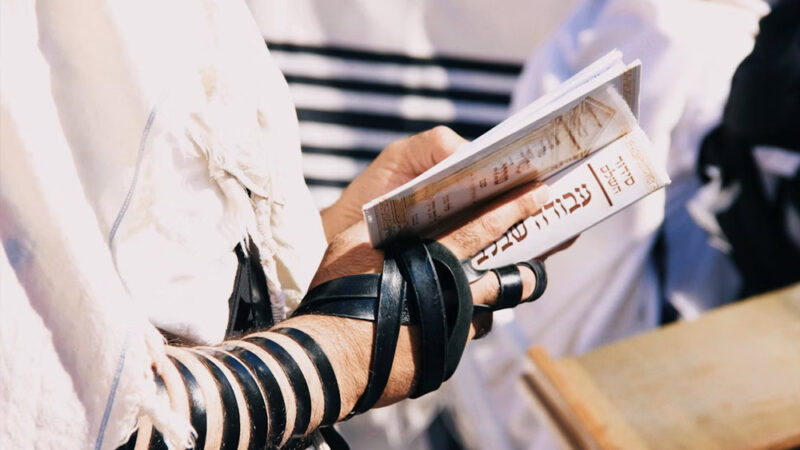
We’ve come to talk about one of the most common Jewish rituals


If you were from another planet, or let’s say – from Switzerland or north Tel Aviv, and you saw a Jew wrapping his arm in leather straps, tying a black box around himself and standing in front of a wall while muttering prayers – you would say: “Ah, here’s another show of post-secular-colonial-masculine-oppressive esoteric mysticism”.
But we, the Jews? We simply call it “putting on tefillin”.
Two small boxes, a lot of black leather, knots, wrappings, a fixed mantra, and your morning is no longer just a morning – it has begun with meaning.
Wait, who invented that anyway?
Tefillin is not an Apple gadget, but an ancient Jewish technology that is thousands of years old.
Think of it as a spiritual USB – one that connects you directly to the Creator, even before coffee.
The concept is simple: take the most powerful verses in the Torah – “Shema Yisrael,” “Vahavta” “והיה אם שמוע” and place them not only in your heart – but physically on your head and arm.
Literally tie yourself to the meaning.
It’s not a symbol. It’s not a metaphor.
It’s – an act.
Every morning – a ritual that makes the heart move a little
To those who have never put on tefillin, they look like a Hasidic accessory or an Orthodox version of BDSM kit.
But the truth? It’s one of the most peaceful, intimate, and precisely the most Israeli things there is.
Because if there’s one thing the average Israeli has trouble with – it’s stopping.
Disconnecting. Put down your cell phone.
And that’s exactly where the tefillin come in – like a hand that places the morning on you anew, and says:
“Breathe. Straighten. Remember why you’re here.”
Tefillin – Most Petah Tikva, Most New York
One of the most amazing things about tefillin is their universality within Judaism.
They are the same in Ra’anana and Brooklyn, in Mea Shearim and the Central Bus Station, at the airport, in a caravan, in the army or on a beach in Thailand.
Putting on tefillin is the most immediate Jewish action.
Without interpretation. Without a speech.
You put on – and you are in.
It doesn’t matter if you are Haredi, traditional, an interested secular or just a tourist visiting the Western Wall –
When you are wearing tefillin, you are exactly like Moses.
More or less. With a little less of a burning bush.
We put on – and we put on
This doubling of “putting on tefillin” is not accidental.
Because putting on tefillin is not only an action – it is also liberation.
From thoughts, from the race, from the ego.
In that moment when you stand wrapped, silent, looking through prayer – something in you calms down.
You don’t have to prove anything.
You are simply present.
Like meditation, only with roots, texts, and a sense of belonging of two thousand years.
And of course – there is also the “Come and lay down, brother”
It is impossible to talk about tefillin without mentioning the phenomenon of the “shlachim” – those young Chabad men with a broad smile, who appear to you just as you are rushing to a job interview, buying a pretzel at the station or considering converting because you missed your flight.
They don’t ask “Are you religious?” or “Do you feel like it?”, but rather ask:
“Brother, did you lay down today?”
And there, in the middle of the noisy street, a pure, personal, simple Jewish moment pops up.
Yes, sometimes embarrassing.
Yes, sometimes surprising.
But almost always – exciting.
What’s the deal with the boxes?
So here is the item that perhaps most symbolizes all of Judaism:
Two black boxes.
Not a shiny object. Not a pagan symbol. Not a picture of a holy man.
Simple – a square box with Verses.
Black, simple, precise, ingenious.
And maybe that’s the point.
Judaism doesn’t compete in beauty – but in meaning.
It doesn’t seek excitement – but in connection.
Tefillin – even if you don’t, remember
Not everyone puts on tefillin, and that’s okay.
But everyone – or almost everyone – knows what it is.
It’s one of the few symbols that is passed down from generation to generation, even without explanation, even without coercion.
Putting on tefillin is something that remains in the background – like a flag, like a family name, like a longing for identity.
And if one day you find yourself on a balcony alone, or on a trip to Europe, or before a defining moment – you will suddenly remember.
Maybe you’ll take an old pair of tefillin, maybe you’ll try.
Maybe you won’t understand everything – but you will feel everything.
Finally – a black box. Heart Open.
In an age of popsicles, apps, cynicism and targeted advertising – there is something almost revolutionary about the fact that a man stands every morning with black leather straps on his body, and talks to the Creator of the world without mediation.
No noise. No likes. No filters.
Just you, yourself, and your tefillin.
And that is – perhaps – the most optimistic thing that can be said about our generation.
Even if everything has changed – there are things that don’t need to be updated in the version.
Just let it be.
And remember – you are already laid down.
הירשמו כדי לקבל את הפוסטים האחרונים אל המייל שלכם