Burqa, Veil, Niqab, Hijab & More: What They Covered — And What They Tried to Hide

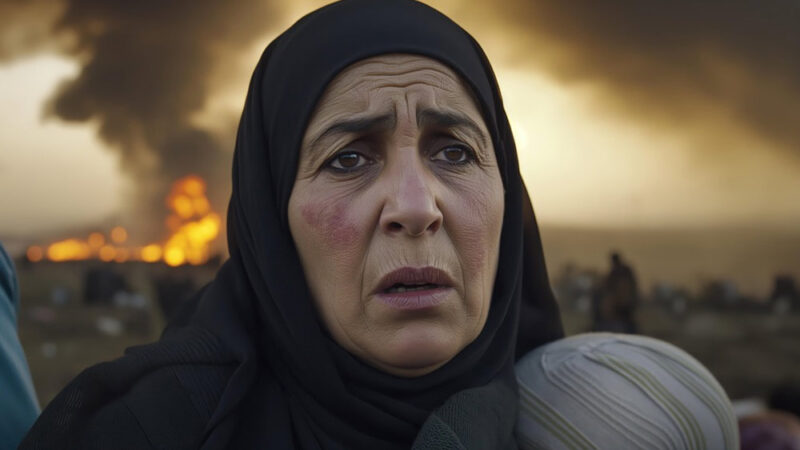
All Coverings and Their Faces
If you’ve ever found yourself tangled between “burqa, hijab, niqab, chador, veil, and more” — names that sound less like clothing and more like exotic menu items — you’re not alone.
And if you’re asking why some women cover their faces, hair, bodies — or all of it — yet we’re told it’s a matter of “free choice” — welcome to the 21st-century liberal West, where logic bows to relativism, and “women’s liberation” includes the right to walk into a wall of fabric.


But before we accept the spin, let’s sort things out — with humor, with reason, and certainly without turning into the Ottoman Bureau of Dress Codes for Europe.
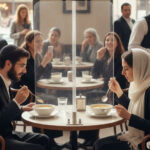
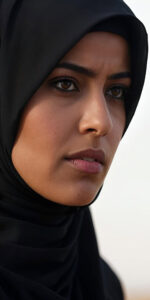 Hijab — The Light Veil for Starters
Definition: A simple head covering that hides hair, neck, sometimes part of the shoulders — but leaves the face visible.
Who wears it: Many — from women in Tehran to immigrants in Ramat Gan.
What it says: “I modestly cover, but I still want cute selfies.”
What it signals: On paper, piety. In practice: an exterior brand showing affiliation with a Muslim identity and the worldview that equates woman → body → danger → covering.
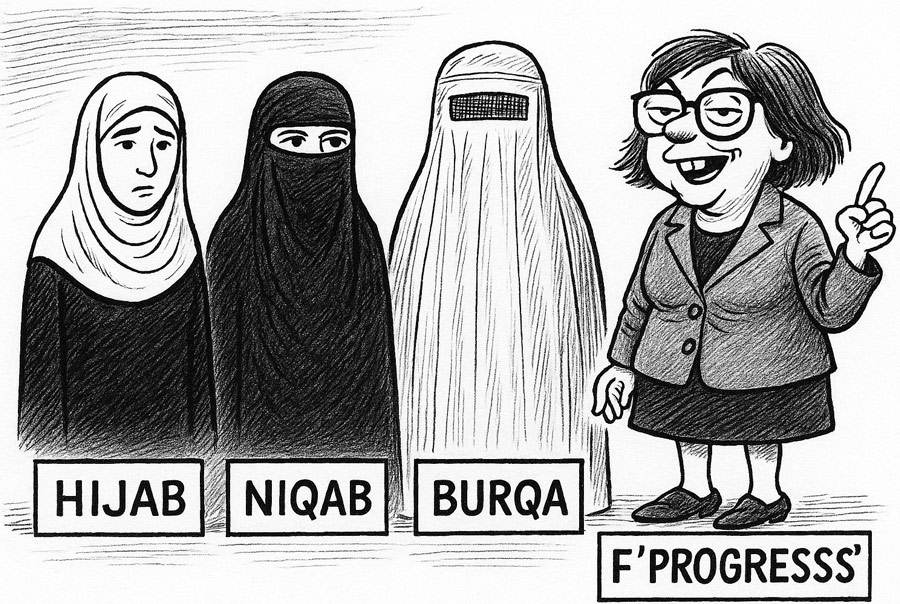
And in the West? It becomes a feminist poster piece. When a Western woman dons hijab, it’s called “choice.” When a Christian nun does—religious repression. Because criticism has reserved spaces.
Niqab — The Partial Vanishing Act
Definition: Covers the entire face except the eyes.
Who wears it: Women who want to be seen just enough to breathe, and no more.
What it says: “I don’t belong here — but if I have to be, at least without a face.”
What it signals: A complete blurring of personal identity — because the face, the expression, the smile might distract a Muslim man from the Quran. Heaven forbid.
In the West, the debate intensifies. Countries like France, Belgium, and Denmark banned the niqab for “public order.” But then Oxford intellectuals rose up, calling it cultural discrimination.
If you can’t identify a person by face but by the color of cloth — maybe it’s time to put a niqab on intelligence itself.
Burqa — The Fully Sealed Mode
Definition: Full-body covering from head to toe, including eyes, typically with a mesh screen to see through. Think of it as a mobile blackout box.
Who wears it: Predominantly in Afghanistan under Taliban rule.
What it says: “If you see me in public, I have surrendered my soul.”
What it signals: Zero visibility, zero presence, zero humanity. The woman as a functional vessel allowed to breathe — quietly.
And in the West? It’s harder to swallow. Even die-hard liberals scratch their heads. Because how do you sell feminism when a woman resembles a navy-blue filing cabinet?
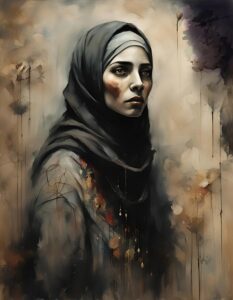 Chador — The Persian Wraparound
Definition: A large sheet of fabric (usually black) draped over the whole body, held by the hands — but not necessarily covering the face.
Who wears it: Women in Iran, particularly among the religious conservative.
What it says: “I’m ultra-conservative, but I still want a minimum of movement.”
What it signals: A feminine reinterpretation of Jonah’s whale story — enter the chador, surrender your shape.
Veil (R’ila / R’ala) — The All-Purpose Cover
Definition: The generic name for any kind of covering worn by women.
Who wears it: Anyone, any style, any era — as long as someone expects it.
What it says: Depends on context. Sometimes a symbol of modesty, sometimes a symbol of control.
What it signals: In Arabic, “separation, partition.” In reality — the opposite of integration.
What About “Free Choice”?
Here lies liberalism’s greatest trick.
When your society whispers that shiny hair is dangerous, or that modesty = virtue, choice becomes a cruel joke.
When a woman must choose between hijab and social boycott, between burqa and familial shame — that’s not “choice.” That’s a cultural pressure cooker dressed in tolerance.
 And when the West applauds “Muslim feminism” while women are crushed under cloth — it’s not hypocrisy. It’s collusion under the banner of inclusion.
Bottom Line?
The issue isn’t the head covering — it’s what it covers:
- The fight for control over a woman’s body.
- The fear of femininity.
- The fear of freedom.
- And the fact that part of the world is still stuck in the 7th century — while we pamper it so as not to offend.
Want to wear hijab? Go ahead.
Want to walk in a bikini? Be my guest.
Want to live in a society where no one interferes with your choices? Find a land without Taliban, without veils, and without leftists calling tyranny “identity.”
Not every covered woman is a victim. But any society that bows to covering rather than asks why it exists — is complicit in the crime.
הירשמו כדי לקבל את הפוסטים האחרונים אל המייל שלכם