
Effortless Salary 💸: Naive Idea or Lazy Genius?

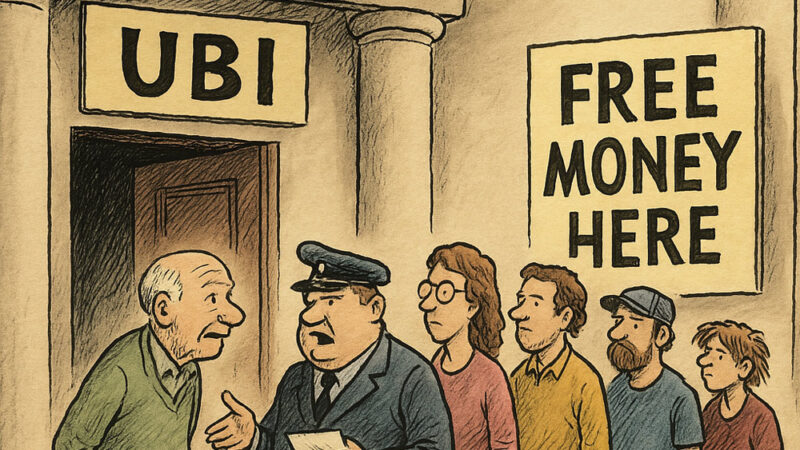
Universal Basic Income (UBI)
Let’s face it — there’s something (literally) intoxicating about the idea that you can stay in your pajamas, not work, and yet the Bank of Israel will deposit money into your account every month. Yes, even if you haven’t written a single line on your resume since the Open University’s Introductory Postmodern Thought course.


Welcome to the strange, promising, and slightly dangerous world of Universal Basic Income — or UBI for short. It’s an idea that excites every smart kid who understands that working is excessive, every leftist philosopher who believes our time belongs to art, and every high-tech guy who’s developing artificial intelligence that will fire us all in two years.
But is this really an amazing social solution fit for the 21st century, or a naive fantasy along the lines of “Peace Now with a Generous Budget”? Well, the answer is… complex, surprising — and doesn’t require you to pay for it. Like UBI itself.
What is UBI anyway?
UBI is a simple idea (so simple, it’s worrying). The state distributes a fixed amount to every citizen every month — without checking how much they earn, where they live, if they work, if they’re healthy, or if they spent all their previous salary on a monkey with glasses NFT.
In other words: no unemployment benefits, no pensions, no income support. Just a flat amount, distributed to everyone — rich, poor, lazy, geniuses, yeshiva students, and Tel Aviv blighters alike.
The logic?
- Reduce poverty.
- Replace the complicated and bureaucratic benefit system.
- Allow people to choose their lifestyles independently of the labor market.
- And most importantly — deal with a future where robots will do everything, and we will just write tweets.
A utopian vision… that is starting to sound less utopian
Imagine a world where every person, from the Golan Heights to Eilat, receives 5,000 NIS every month, no matter what. The policewoman, the programmer, the settler, the gender studies student, and the gray market investor. Everyone is equal. Everyone smiles. Everyone votes for the politician who promised them another thousand.
Sounds lovely, right? Until you understand what it actually means:
- People will stop working — at least some of them.
- People Yes they will spend the money — some on food, some on juliennes.
- People will get used to not working, but they won’t stop complaining.
On the other hand — maybe, just maybe — we will also see people finally free themselves from the endless race, start a startup, learn to play an oud, or simply become less stressed people. And that’s no small thing.
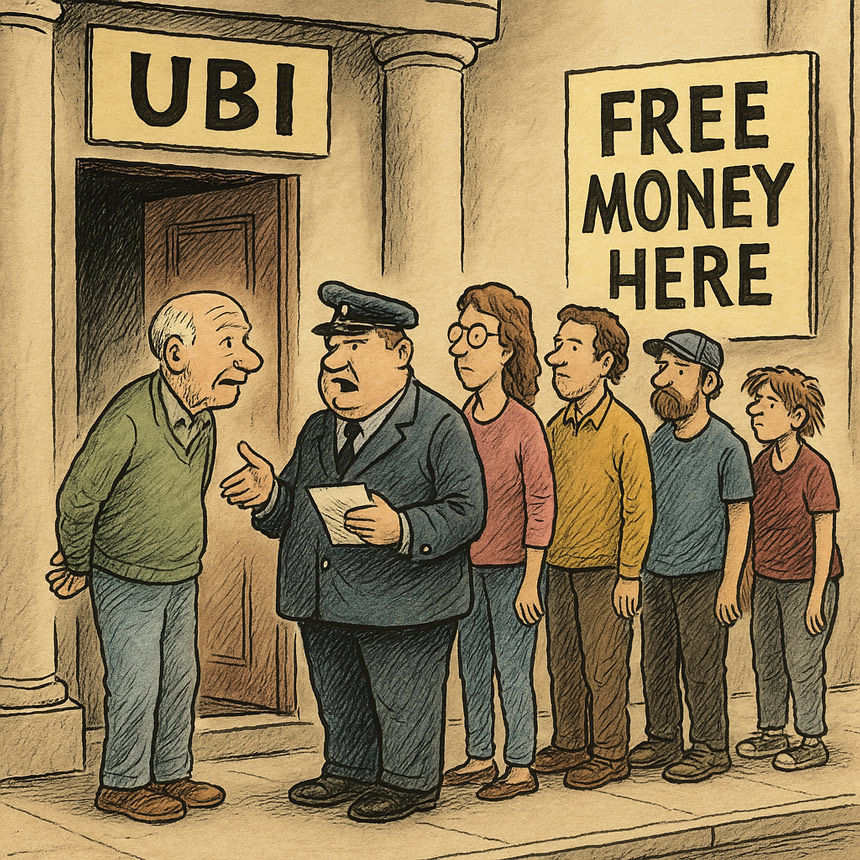
Test case — Finland, Alaska, and a friend from Beersheba
So where did they try it?
Well, Finland conducted a two-year experiment: 2,000 unemployed people received a fixed monthly payment of about 560 euros. The results? Some really looked for work more diligently, and some simply lived in peace with themselves and with coffee without sugar. The indicators did not show an economic miracle, but neither did they show a collapse. In short: Finnish peace.
Alaska, through the “Petroleum Fund”, distributes an annual dividend to its residents. Result: very broad public support, a positive effect on mental health, and less crime. Bears are also more peaceful, but that’s an anecdote.
And in Israel? They once tried to give everyone a corona grant — and we got a blitz of stories about pool parties, Tempur mattresses, and moral insults to those who “didn’t really need it.” But still, it really helped many. Including my friend From Beersheba, thanks to which he finally replaced the third-generation smartphone.
The challenges — because money doesn’t grow on trees (except from the Bank of Israel)
Here comes the part that is less pleasant to discuss — the cost.
A country that distributes money to every citizen has to finance it. That is: taxes. Lots of taxes. Even on those who already work, pay, and sometimes even help their grandmother with shopping.
This puts the whole matter in a sensitive light: How do you get a hard worker to keep working, when his neighbor receives the same amount without leaving home? How do you make sure that personal motivation and responsibility don’t disappear?
And what will you do when politicians start competing among themselves to see who will guarantee the fattest UBI? This already sounds like a formula for Italian socialism with an Israeli twist.
But… maybe it does?
And now the positive part — because there is a lot of it:
- The idea of basic economic freedom is worth discussing.
- The ability of a person to choose how to live, without worrying about the children’s cereal — is worthy.
- The fact that welfare systems are cumbersome, suspicious, and harmful — does require a simple and comprehensive solution.
And now — when the world of work is really changing at a record pace (thanks, GPT), and many professions are simply disappearing — perhaps this idea is no longer utopian, but simply logical.
It’s not that we should adopt UBI tomorrow morning, but we should ask: is there a way to allow people not to be poor without asking them to fill out forms, stand in line, and prove that they are poor?
Summary: Between freedom and overlap
UBI is like a generous grandmother — giving you money, without asking why, just because she cares. The question is whether society as a whole can afford to become To Grandma.
If we do this out of responsibility, thinking, and a desire to strengthen freedom and not lull the people — perhaps we can discover that our future is not only smarter, but also more humane.
And if not — we can always start a podcast, ask for donations on Patreon, and say that we are researching the issue in depth. This is UBI in the 2025 version.
הירשמו כדי לקבל את הפוסטים האחרונים אל המייל שלכם