
Emotional Eating: From Carbohydrates You Came, and to Soufflé You Shall Return

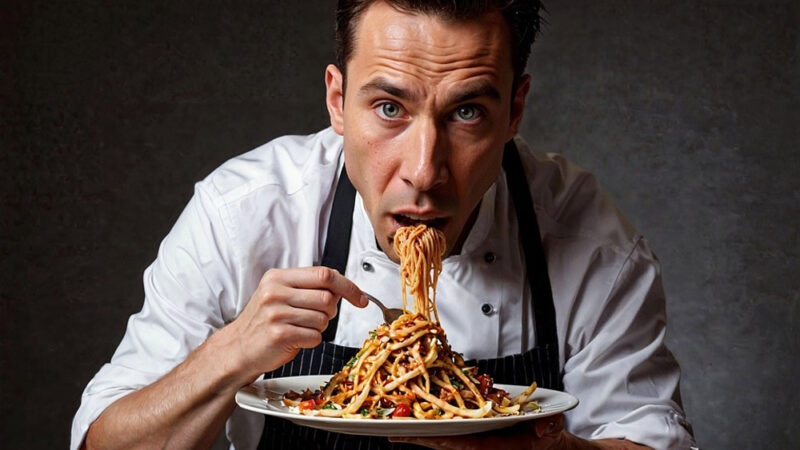
A bittersweet opening


You’re not hungry.
You’re sad. Or bored. Or lonely. Or you just watched the news for more than five minutes.
And yet, somehow, you’re standing in front of the fridge, staring deeply into a tub of hummus, wondering why the tahini suddenly looks like a warm hug from your mother.
This is emotional eating – the unbalanced sibling of dieting and the closest companion of Monday morning.
You didn’t plan to eat seven bourekas. You just wanted some peace.
And you found it, briefly, inside dough.
🍫 “I don’t eat when I’m sad,” said no one. Ever.
Emotional eating is not a nutrition problem. It’s a consciousness problem.
When someone says, “I eat when I’m sad,” they don’t mean rice cakes.
They mean ice cream, pasta, chocolate, and a pita that somehow spreads itself with Nutella, as if controlled by a Netflix algorithm:
“If you enjoyed despair, you might also like marshmallows.”
Nobody seeks comfort in lettuce.
Have you ever tried crunching cabbage after a heartbreak? Exactly.
Emotions, Calories, and Everything In Between
The human brain is beautifully designed – but not particularly wise.
It senses discomfort and immediately looks for a reward.
What’s the fastest reward? Food.
What’s the most addictive? Sugar.
What’s most available during adolescence? Unprocessed trauma and a pantry full of Bamba.
In other words: your inner child doesn’t want a hug.
It wants whipped cream.
And the responsible adult? Busy justifying it.
“I’m eating because I’m stressed.”
“I had a hard day.”
“I need energy to think of solutions.”
“The pita begged me. I saw it in its eyes.”
Emotional Eating Is Politics – Just With Fewer Shouts
Think about it for a moment. Emotional eating is like an internal coalition government.
You have a Minister of Health yelling: Salad!
You have a Minister of Finance yelling: Buy a snack and end this already!
And then there’s the Police Commissioner, awake at 3 a.m., eating cornflakes straight from the bag, politely asking the neighbors not to judge.
It’s a government of emotions.
And everyone is hungry.
A Binge Is Not a Dirty Word (But It Does Have Crumbs)
For most people, there’s a moment when eating stops being about pleasure and becomes about distraction.
You don’t taste. You don’t feel full.
You just perform a sequence of actions meant to fill something else.
It starts with “a little snack while watching a show”
and ends with you checking the top of the fridge, just in case the last cookie escaped there.
It’s okay. We’ve all been there.
Just don’t say, “Just one more bite.”
That’s the oldest emotional scam in history – second only to “I’m just calling to ask one quick question.”
“I Have It Under Control” – And How’s That Working Out?

Emotional eating is like a bad romance.
You know it’s not good for you, but it’s comforting.
You’re drawn to it. And it shows up exactly when you’re weakest.
There’s always that moment:
“This time I won’t fall for it.”
Then comes a hot day.
A traffic jam.
An annoying message.
And suddenly you’re buying three chocolate milk cartons like a construction worker who just came down from Haifa to tile a floor in Gedera.
It’s not that you’re weak.
You’re human.
A human with a stomach. And emotions. And an impressive ability to justify things involving donuts.
Why It’s Not the Solution – Even If It Tastes Amazing
The problem with emotional eating is that it doesn’t solve the emotion.
It just covers it. Like a Band-Aid on heartbreak.
Or singing loudly so you don’t hear the phone staying silent.
Sometimes it’s not sadness.
It’s boredom.
It’s lack of purpose.
It’s fear.
It’s habit.
It’s the need to feel in control when everything else feels like it’s slipping away.
Food doesn’t answer those things.
It just sits quietly with you.
Sometimes alongside 1,500 calories.
So What Do You Do? (Besides Crying Into a Sandwich)
You don’t need to become a meditation guru.
But you can start noticing:
Are you hungry – or just sensitive?
Do you need food – or attention?
Do you really want this – or is it just there?
And if you already ate – don’t punish yourself.
Laugh about it. Stand up. Try differently tomorrow.
Because if you’re going to emotionally eat, at least do it with self-awareness.
And ketchup.
Emotional Eating, Israeli Style – With Tahini on the Side
We’re a warm people. Expressive. Dramatic. And very carbohydrate-oriented.
What do we eat during shiva? Bourekas.
What do we bring a new mother? Cakes.
What do we do after a military operation? A barbecue.
What helps us survive winter, summer, spring, autumn, and the last bad date? Shawarma with everything.
That’s the Middle East.
Here, emotions and food walk hand in hand.
Sometimes they fall asleep on the couch together.
Go Through the Stomach – Just Don’t Forget the Heart
Emotional eating is not a failure.
It’s a signal.
It’s the body and mind saying:
“I need something. Someone. Attention. Understanding. Maybe also a pita.”
So next time you’re standing in front of the fridge, pause for a second.
Ask yourself: What do I really need right now?
And if the answer is “ice cream” – fine. Eat it.
Just know it’s not instead of the emotion.
It’s alongside it.
And sometimes, eating a little less
is the most emotional act of all.
הירשמו כדי לקבל את הפוסטים האחרונים אל המייל שלכם