Purim 2026 – Sirens, Ballistic Missiles, Drones… and Still Israel “Joyful and Triumphant”

There is something almost illogical about Purim 2026.


On one side – sirens. Ballistic missiles. Iranian drones traveling from Tehran through its franchises in Lebanon, Yemen, and Gaza. Hezbollah rockets streaking north to south.
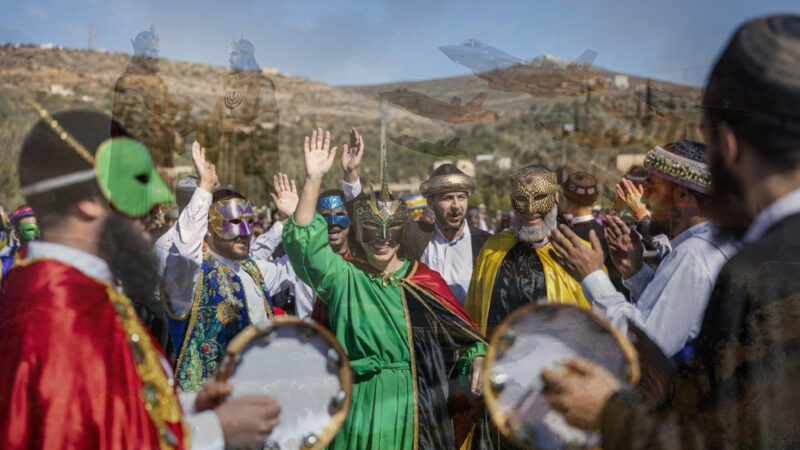
On the other – costumes. Mishloach manot. Masks. Music in the streets and, yes, in bomb shelters. And above all – a clear public sense of victory. Not blind euphoria. Not drunken hysteria. A cold, sober kind of victory, born out of years of living under threat.
This Purim was not just a holiday. It was a historical reminder. Almost too perfectly scripted. Once again a Persian empire. Once again an existential threat. Once again Jews marked as a target. And once again – a reversal.
Iran Sought Strategic Strangulation – It Got Strategic Exposure
For two decades, the Islamic Republic built a tightening ring around Israel. Hezbollah in the north. Hamas in the south. Shiite militias in Syria. The Houthis in Yemen. Money and weapons wherever a spark could ignite.
The plan was simple: surround, exhaust, erode, deter. Turn Israel into a country permanently under pressure until it retreats inward and loses initiative.
The past two years – culminating in Purim 2026 – marked the peak of that strategy. They also marked the beginning of its unraveling.
The moment Iran and its proxies escalated openly, firing missiles across borders – even toward Europe – they lost their central advantage: ambiguity. Suddenly the puppet master was visible. Suddenly the conversation was no longer about “another round in Gaza,” but about a direct confrontation with a regime that openly calls for Israel’s destruction and funds it as state policy.
And once something becomes explicit, it becomes legitimate to respond explicitly.
America Returned – Not Through Tweets, but Through Aircraft Carriers
This campaign was not Israel’s alone.
Unlike the previous decade, when Israel often felt it was fighting a holding action almost by itself, this time the American presence was unmistakable. Naval fleets in the Gulf. Joint air-defense systems. Overt intelligence coordination.
The message was clear: Iran is not merely an Israeli problem. It is a regional and global one.
For Israel, this marks a dramatic shift. For years it warned that Iran’s nuclear ambitions and Shiite imperialism posed a worldwide threat. During Purim 2026, that claim lit up radar screens in real time.
“V’nahafoch Hu” – Not a Slogan, but Policy
In the Book of Esther, the pivotal moment is the reversal. The Jews who were meant to be annihilated were granted the right to defend themselves. In Purim 2026, the reversal was strategic.
Iran intended to terrify Israeli society. Instead, it faced a society that kept working, studying, going out – and celebrating. Not because it dismissed the threat. But because it understood that fear is part of the battlefield.
This is more than resilience. It is a shift in consciousness. Israel in 2026 no longer operates from daily existential panic. It operates from the understanding that it possesses real power – military, technological, intelligence-driven – and that when it absorbs a blow, it can strike back.
And today, across much of the world, the same phrase is being spoken with increasing clarity: Israel is a power. Perhaps the smallest power on earth – but undeniably a power. Technologically. Militarily. Intelligently. Politically. And above all – ideologically.
Drones in the Sky, Masks on the Ground
There is something almost literary about the images of this Purim. Children dressed as superheroes while hostile drones cross the sky. Colorful bomb shelters while news channels stream live interception footage.
But perhaps it is not irony. Perhaps it is the point.
Purim has always been about concealment and revelation. Masks that hide faces. Reality that hides providence. In 2026, another mask was torn off – the mask of the Shiite warlord, the so-called “master of proxies.”
The world can now see clearly who pulls the strings. The confrontation is no longer about one border or another. It is about the very existence of a sovereign Jewish state in the Middle East.
And when that becomes clear, unity becomes clearer too.
The Israeli Public – Not Naïve, But Determined
There were casualties. There was damage. There were sleepless nights. No one is romanticizing this.
Yet something in the public response felt different. Less panic. Less collapse. More composure.
Years of living under threat have produced not indifference, but disciplined adaptation. Israel did not “get used to” danger in the sense of surrendering to it. It learned to manage it.
Put simply: the enemy tried to break routine. Routine refused to break.
The Entire Region Is Watching
Purim 2026 is not merely an Israeli episode.
Gulf states are watching closely – cautious, calculating, defensive, reconsidering direct involvement. Jordan and Egypt are reading the wind. Turkey received an unexpected Iranian “visit” in the form of a missile. Even in Europe, policymakers are beginning to grasp that the Iranian threat is not theoretical.
If Israel is seen as initiating and prevailing in a direct confrontation – as America’s most capable and reliable ally in the region – the implications are far-reaching. It reshapes normalization agreements. Security partnerships. Economic trajectories for the coming decade. The way Arab states evaluate both Tehran and their own alignment with the West.
In the Middle East, visible weakness is punished. Visible strength commands respect – and often quiet.
Happy Holiday? Yes. Naïve? Not Even Close.
“Joyful and triumphant” in Purim 2026 is not escapism. It is declaration.
We are here. We are not folding. We are not canceling a holiday because someone in Tehran launched another explosive drone. Perhaps we postpone a parade. Perhaps we celebrate partly in shelters. But we celebrate.
There is something educational about it. A generation raised on the story of Esther now sees that Jewish history did not end in ancient Persia. It continues – with different technologies, different theaters, but the same principle: self-responsibility and self-defense.

Between the Scroll and Reality
No one claims the story ends tomorrow. Iran will not disappear overnight. Its proxies will not voluntarily dissolve. The campaign is far from over.
But in Purim 2026, something shifted. Initiative changed hands. A sense of siege gave way to a posture of standing firm. Not intoxicated triumph. Sober confidence.
For a small nation surrounded by adversaries, that is not symbolic. It is strategic.
Perhaps that is why, between one siren and the next, people still step into the streets. Not out of recklessness. Out of choice.
If Jewish history teaches one recurring lesson, it is this: those who seek our disappearance eventually confront an inconvenient fact – we are remarkably bad at disappearing.
Purim 2026 is not merely another holiday under fire. It is a sharp reminder that even in an era of precision missiles and suicide drones, there is one thing extremely difficult to intercept – a national will to live.
And in the Middle East of 2026, that may be the most strategic asset of all.
הירשמו כדי לקבל את הפוסטים האחרונים אל המייל שלכם