
The Boomerang Effect: Why Israelis Come Home Exactly When Everything Is on Fire

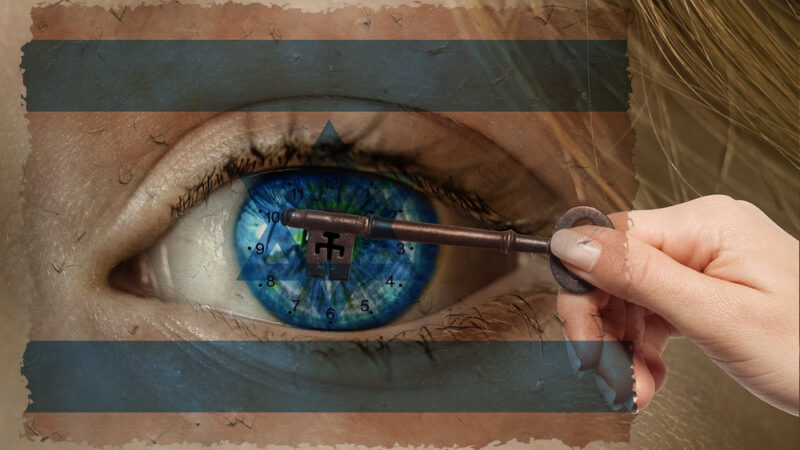
What Are All Those European Passports Really For ?
For years, Israel has maintained an unofficial rite of passage: acquiring a foreign passport.
Polish. Romanian. Portuguese. Lithuanian. French. Anything-as long as it’s not Israeli.


The unofficial slogan of the “Visa Generation” was simple: “Just in case.”
Just in case there’s a war.
Just in case the government collapses.
Just in case the Supreme Court ruins your garden.
Just in case Israel becomes… Israel.
A backup plan. A lifeboat. A stylish European exit door with good coffee and functioning trains.
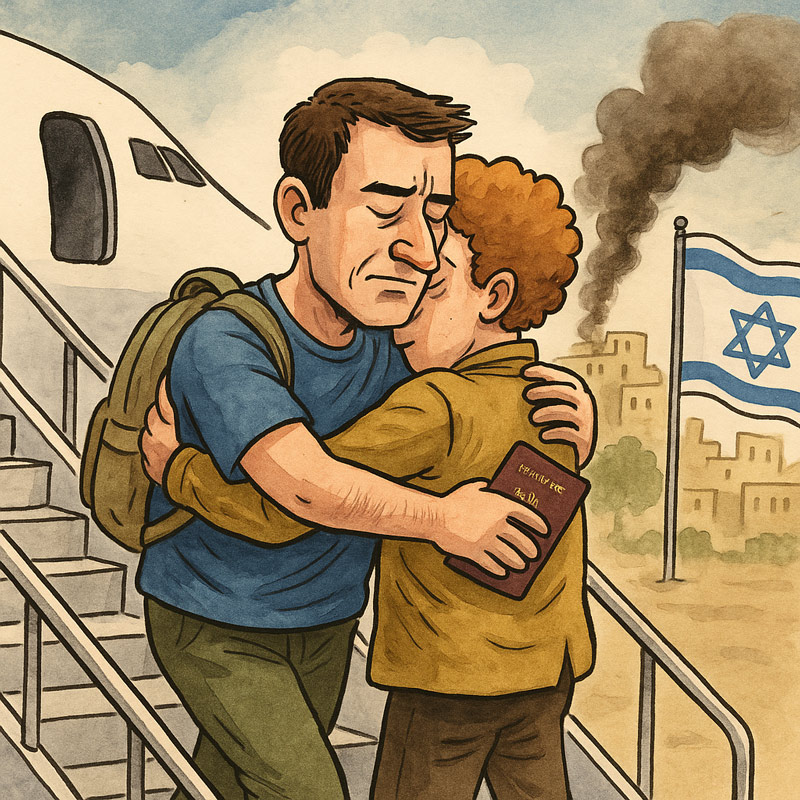
And yet-precisely when the sky fills with smoke, when fighter jets roar over Tel Aviv, when Hezbollah’s threats start sounding less like rhetoric and more like a work schedule-something strange happens:
Israelis come back.
Wait-Why Would Anyone Return Now?
On paper, it makes no sense.
After all, people worked very hard for those passports. They filled out archives, traced great-grandparents, endured bureaucratic torture in broken Polish and nostalgic Portuguese. They rented apartments in Amsterdam. Took techno courses in northern Holland. Learned to pronounce “Schiphol” correctly.
So why, when the threat becomes real, do planes suddenly fill with Israelis in leggings and oat-milk lattes heading back to Ben-Gurion?
The answer lies in a word that much of the establishment apologizes for even mentioning:
Zionism.
Yes. That word.
The one that sounds like profanity in certain TV studios.
The one treated like an embarrassing family secret in elite circles.
Despite years of fashionable Tel Aviv attempts to delete history, replace flags with therapy jargon, and turn national memory into trauma workshops-most Israelis still feel it, deep down:
This is home.
And when your home is on fire, you don’t flee.
You run inside to save the couch.
So Who Are the Returnees?
 Sociologists will tell you it’s mostly the “middle generation”:
Israelis who left in the 2000s for the U.S., Canada, Australia-seeking economic stability, Western comfort, and public services that don’t make you cry.
But when Hamas rockets hit Tel Aviv, when the air fills with that familiar sense of shared fate, something clicks:
Nothing over there feels like home.
And no amount of Western moral lectures about equality can mask a simple truth:
If Israel falls-there is no “Plan B.”
You can take the Israeli out of Israel.
You cannot take Israel out of the Israeli.
Especially if he’s living in Los Angeles and suddenly misses shawarma from Abu Khalil and traffic jams on the Ayalon.
A National Slap to Progressive Cynicism
This return-precisely when it’s hardest-is a slap in the face to every attempt to engineer a purely “civic” identity detached from Jewish-Israeli nationhood.
It proves-uncomfortably for some-that words like belonging, peoplehood, and homeland still mean something. Even in 2025. Even without hashtags.
And no-it’s not just “right-wingers.”
Many of the returning Israelis are former self-exiled leftists. The same ones who land at Ben-Gurion, lower their heads, swallow their post-colonial critique, and say:
“We’re here. Tell us what needs to be done.”
Because when the sirens go off, progressivism dissolves-and national identity resurfaces.
Even the most condescending cynic wants to be with his family when things get real.
An Unsexy Kind of Love
Love for Israel isn’t Hollywood romance.
It’s not a smooth narrative with a happy ending.
It’s commitment, not fantasy.
It includes HMO waiting lines, road rage, and rent prices that feel like fraud.
And yet-it’s deeper, hotter, and stronger than comfort abroad.
That’s what confuses Europeans the most:
A country with constant existential threats, dysfunctional airports, and neighbors who openly want it destroyed-still manages to pull its people back.
Voluntarily.
So What Now?
Now comes clarification.
Thousands returning from abroad.
Reservists reporting without being called.
People coming back simply to be here.
It revives the old question: Why are we here?
And the answer is simple-and powerful:
Not because we have no choice.
But because we want to be here.
Because belonging beats comfort.
Because meaning beats moral superiority.
Because living under Iron Dome still feels more honest than living under a San Francisco roof while pretending neutrality.
Conclusion: Zion Is Not for Sale
This phenomenon isn’t an anomaly.
It’s proof that Zionism never died.
It just waited quietly-until it was needed.
Not in slogans.
Not in flags.
But in actions.
It lives in the instinct to fly home when it’s dangerous.
In the bond between people and land-even when that person heats pita in a London microwave.
Yes-we’re complicated. Loud. Argumentative. Permanently irritated.
But when it matters-we come home.
And that, thankfully, is worth more than any Portuguese passport.
הירשמו כדי לקבל את הפוסטים האחרונים אל המייל שלכם