The Mezuzah: A Small Box for Spiritual Life Insurance



Mezuzahs. Yes, mezuzahs.
You’d be surprised how much depth hides inside that tiny box stuck to the doorframe—quiet, tilted, and secretive, like it knows something you don’t.
By: Someone who still isn’t sure whether to kiss it or salute it
There it is, on the door. It doesn’t make a sound, doesn’t charge rent, doesn’t need batteries. It just stands there—always slanted, always watching. Every Israeli has passed by it thousands of times, most of us giving it a gentle touch or a finger-kiss, as if it were a protective grandmother warding off the evil eye.
But before you ignore it again on your way to the bathroom—stop for a second!
The mezuzah isn’t just a relic. It’s a psychologist, a gatekeeper, a Mossad agent, and a spiritual GPS—all packed into something the size of a permanent marker.
So what is a mezuzah, anyway?
According to Jewish law, a mezuzah is a parchment scroll inscribed with two biblical passages—Shema Yisrael and Vehaya im shamoa—reminding us to love God, remember His commandments, and (unofficially) to turn off the water heater.
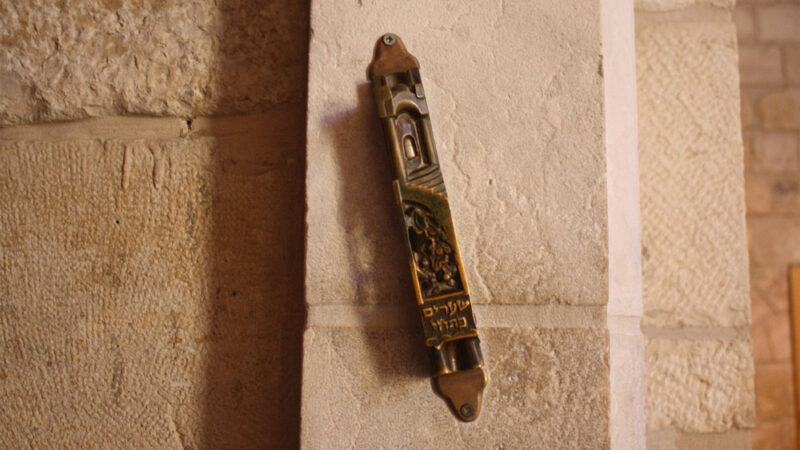
That sacred scroll is rolled up and placed inside a case—metal, plastic, Hebron olive wood, shiny glass, or hand-painted ceramic from Safed (priced, of course, like a full set of designer Shabbat candles).
And on the case, there’s always the Hebrew letter Shin.
Not for shalom (peace), shechinah (divine presence), or shawarma, but for Shaddai—one of God’s names. And honestly? It just makes it look more official.
How did the mezuzah become so… Israeli?
Think about it: it’s a religious object that somehow became a universal, everyday Israeli symbol—accepted by everyone from Tel Aviv atheists to ultra-Orthodox Jerusalemites.
“Welcome” sign? Optional.
Cat-shaped doormat with a kippah? Cute, but temporary.
Mezuzah? Mandatory.
Whether you live in a secular kibbutz in the Galilee, a Tel Aviv high-rise, or a rented apartment in Kiryat Yam—there’ll be a mezuzah. It usually stays there long after you move out, too.
It’s like an old army postcard—nobody knows who put it there, but no one dares take it down.
🚪 The door’s best friend
Every door dreams of not being empty. A picture? Maybe. A shelf? Fine. But a mezuzah? That’s prestige.
In many ways, it’s what turns a building into a Jewish home.
It’s the house’s ID card, declaring: “People who care live here. Or at least people who don’t want to take unnecessary risks.”
Because more than anything, a mezuzah is a kind of spiritual insurance policy.
It doesn’t promise nothing bad will happen—but it makes you feel someone’s watching out for you.
And in Israel, where everyone’s a little on edge, a little superstitious, and always looking for signs from the universe—that’s worth a lot.
Common side effects of owning a mezuzah
Finger-kissing reflex
Even the most secular Israeli—the one who believes in “the universe,” quantum energy, and express Wolt deliveries—can’t resist giving it a quick touch on the way out. It’s not faith; it’s muscle memory. Like checking the door lock or saying “yalla bye” five times before hanging up.
“Maybe check the mezuzahs?” syndrome
Something bad happens? Someone’s sick? The neighbor starts playing an Indian flute at 2 a.m.?
Immediate reaction: “Maybe it’s the mezuzah.”
As if it’s a clogged water filter that just needs a rinse.
And when the scribe finds one letter smudged—boom! Balance restored. “Told you—it was the mezuzah!”
Crazy design variety
From Yellow Submarine mezuzahs to Polynesian-themed ones—anything goes.
Once, mezuzahs were simple. Now they come with Bluetooth, GPS, and voice recognition.
All that’s missing is one that orders you a cab when it senses you’re stressed.
When the mezuzah meets Israeli reality
In a government office: right next to the “No Public Reception” sign—both guarding the entrance.
In a luxury tower: the mezuzah costs more than the rent on the 12th floor.
In a shared apartment: the one object everyone agrees on—the vegan, the hipster, and the religious engineering student who makes chicken soup once a week.
A small box with a massive meaning
 It’s easy to forget, but inside that little case are words about love, devotion, and memory.
“Teach them to your children.” “When you lie down and when you rise.” “Write them on the doorposts of your house.”
Each phrase is a call to live with awareness, values, and responsibility.
So no, it’s not just a decorative trinket.
It’s a declaration—not to others, but to yourself.
In conclusion: the mezuzah is like a grandmother
Small, quiet, nonjudgmental, always there.
You might forget about her—but when you notice her, you feel a little warmer inside.
She doesn’t shout, flash, or send notifications. She just gently reminds you, every time you walk through the door:
You’re not alone. Someone’s watching over you. And some things are worth remembering.
And yes, maybe a little kiss wouldn’t hurt—
for Grandma, and for the mezuzah.
הירשמו כדי לקבל את הפוסטים האחרונים אל המייל שלכם