Maybe It’s Time to Teach the Kangaroo Arabic

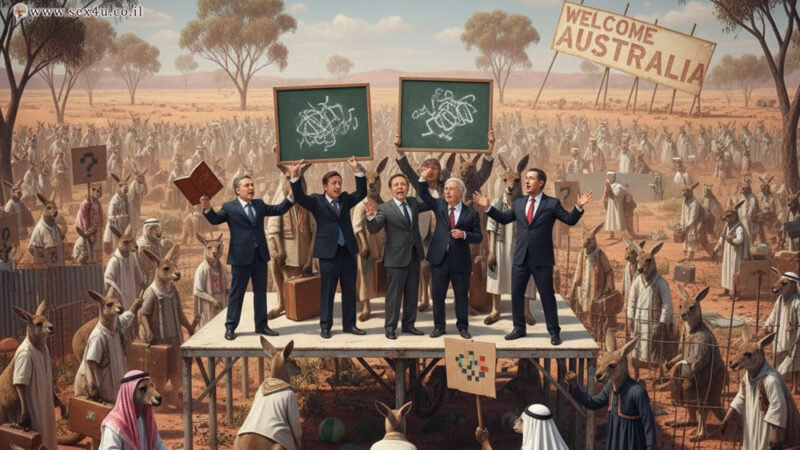
How Australia Discovered That Being an Island Isn’t a Migration Policy


Australia has always loved a clean, comforting story about itself:
An island.
Water on all sides.
Kangaroos.
Peace and quiet.
A country blessed with natural borders, absurd distances, and an ocean that politely keeps uninvited guests away. A geographical dream for anyone who believes borders are physical facts rather than acts of political will.
And then the migrants arrived.
In large numbers.
By boat.
With cultural luggage heavier than carry-on allows.
Suddenly, the island didn’t feel quite so isolated.
The Invasion You’re Not Supposed to Call an Invasion
In Australia – like in much of the Western world – there are words you’re not supposed to use.
“Invasion” is one of them.
So instead, it’s framed as a “humanitarian challenge”.
Or a “regional complexity”.
Or a “dynamic multicultural process”.
In practice?
People arrive in numbers the state cannot realistically absorb,
with limited screening,
no serious integration requirements,
and zero expectation beyond “don’t offend anyone”.
But relax – the government is “aware of the issue”.
A Government That Talks Fluently and Acts Poorly
Australian governments change.
The speeches get updated.
The buzzwords rotate.

Reality, however, stays stubbornly the same – like a kangaroo frozen in the middle of a highway.
Everyone promises a “balanced approach”.
Everyone commits to a “comprehensive solution”.
And every real decision gets postponed so no activist group, newspaper, or human rights NGO with a loud social media presence gets upset.
Because in modern Australia, the greatest fear of a politician
is not losing control,
but landing a hostile headline in The Guardian.
Multiculturalism: When the Host Is Asked to Adjust
The official idea is beautiful:
Everyone is equal.
Everyone brings culture.
Everyone enriches the whole.
The real-world version is less poetic.
Instead of newcomers learning the local code,
the local code bends.
Suddenly there are neighborhoods where English is optional.
Laws become “culturally sensitive”.
New taboos appear – not in legislation, but in schools, workplaces, and public discourse.
And the kangaroo?
Still hopping around,
but increasingly unsure what country it’s in.
Security? Please Don’t Ask Uncomfortable Questions
Australia really dislikes connecting migration to problems.
It’s considered impolite.
Statistics?
“Complex”.
Discussions about crime, radicalization, or failed integration?
“Problematic framing”.
So we arrive at the strangest situation of all:
everyone can see something isn’t working,
but no one is allowed to say what.
Because if you do,
you’re not critical.
You’re “something-phobic”.
The Island That Forgot It Was an Island
The bitter irony is that Australia once knew how to be strict.
Clear immigration policy.
Screening.
Enforcement.
Then came the era where borders became awkward,
and “sovereignty” started sounding like an embarrassing colonial relic.
And so a country defined by extreme geographic isolation
managed to lose control –
not because of geography,
but because of ideology.

So Maybe It Really Is Time to Teach the Kangaroo Arabic
Not because it’s inherently bad.
But because it’s a symptom.
A symptom of a state afraid to say:
We have a culture.
We have laws.
And we have the right to expect newcomers to adapt – not the other way around.
Australia can still stop.
Still choose.
Still decide to be a country, not a social experiment.
But that requires a government willing to absorb criticism,
not just delete tweets.
In Conclusion – No Boomerangs Thrown
Australia’s problem isn’t migrants.
It’s a lack of nerve.
A lack of nerve to say “enough”.
A lack of nerve to defend identity.
And a lack of nerve to understand that multiculturalism without boundaries
is just chaos with good PR.
And if nothing changes,
don’t be surprised if one day
the kangaroo really does reply:
“Sorry – can we do this in Arabic?”

הירשמו כדי לקבל את הפוסטים האחרונים אל המייל שלכם