
What Has the Jewish People Actually Learned Since the Exodus

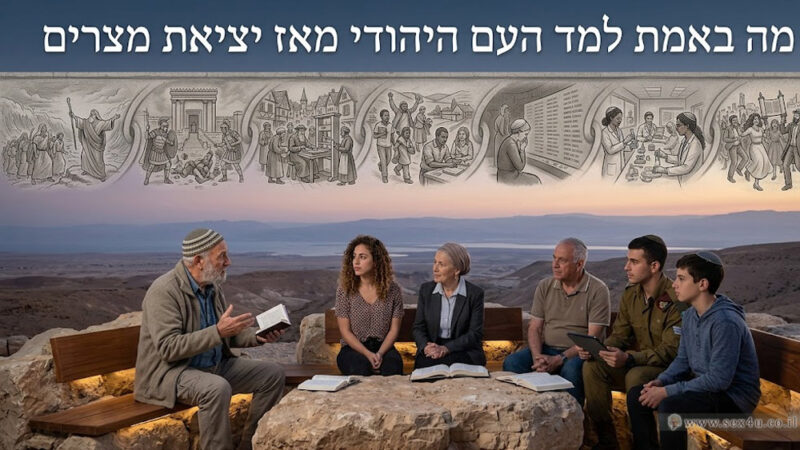
And How It Shows Up in Passover 2026
There are nations that learn from their history.
There are nations that repeat it.
And then there are the Jews –
who document it, read it every year,
and still manage to be surprised.


Passover, somewhere between supermarket discounts and family logistics,
isn’t just the Festival of Freedom.
It’s the annual reminder that we’ve already seen this movie.
We left slavery.
Crossed a desert.
Received a moral framework.
Built a state.
And then, somehow,
we found a way to argue about everything.
Again.
Lesson One: Don’t Rely on Pharaoh
 Lesson Two: Don’t Rely on Anyone – Including Ourselves

The Exodus delivered a fairly clear takeaway:
If your fate depends on others – you’re in trouble.
Simple enough.
Fast forward a few thousand years,
and we’re still debating whether to rely on ourselves
or outsource responsibility to someone with better PR.
Once it was Pharaoh.
Today it’s more sophisticated.
But the principle?
Unchanged.
The problem is that the Jewish mindset,
much like the average Israeli one,
learns a lesson – and immediately adds a footnote.
“Don’t trust outsiders…
unless it’s politically convenient.”
Freedom: A Beautiful Idea, Until You Define It
Passover is the holiday of freedom.
Which sounds great,
until you ask: freedom from what?
Once, the answer was obvious:
slavery.
Today?
Work.
Mortgages.
Family WhatsApp groups.
The news cycle.
Everyone has their own version of Egypt.
The irony is hard to ignore.
We celebrate freedom
in an era where people can’t go five minutes without checking their phones.
We left Egypt.
But never quite escaped notifications.
The Matzah: Bread of Affliction or Lifestyle Product?
Officially, matzah is “the bread of affliction.”
In 2026?
It’s a premium product.
Spelt matzah.
Gluten-free matzah.
Organic matzah.
Ethically sourced, guilt-free matzah.
A nation that once fled without time to let dough rise
now compares textures and brands.
Progress.
Unclear in which direction,
but progress nonetheless.
“And You Shall Tell Your Child” – or Just Google It
One of the central commandments of the Seder:
“And you shall tell your child.”
Pass it on.
Explain.
Teach.
In Passover 2026, it looks like this:
The child asks a question.
The parent opens Google.
The child already found an answer on TikTok.
And the story?
Lost somewhere between algorithms.
Because when information becomes endless,
understanding becomes optional.
The People of the Book
slowly becoming
the People of the Link.
 The Four Children – Now with WiFi

Once there were four sons:
The wise.
The wicked.
The simple.
And the one who doesn’t know how to ask.
Today?
We’ve upgraded.
The wise one reads LinkedIn threads.
The wicked one dominates comment sections.
The simple one is still trying to fix the WiFi.
And the one who doesn’t know how to ask –
never looks up from the screen.
The categories remain.
The format evolved.
 “In Every Generation” – A Line That Refuses to Age
The Haggadah states:
“In every generation, they rise against us.”
Unlike most things,
this line hasn’t needed an update.
Because reality keeps it relevant.
And perhaps that’s the most uncomfortable lesson:
The world hasn’t changed as much as we hoped.
Pharaohs evolve.
Settings change.
Challenges remain.
This isn’t about fear.
It’s about memory.
Statehood: The Exodus, Startup Edition
If the Exodus were a startup,
it would be considered a success story.
Small nation.
Impossible conditions.
Uncertain future.
Now look at Israel in 2026:
Strong.
Innovative.
Economically advanced.
And still –
arguing internally like we’re somewhere in the desert.
Because if there’s one thing the Jewish people never lost,
it’s the ability to debate
even when things are going relatively well.
Is that the secret of survival?
Or part of the problem?
Possibly both.

So What Did We Actually Learn?
This is the question hovering over every Seder table.
And the answer, as always, is complicated.
We learned how to survive.
We learned how to adapt.
We learned how not to give up.
But did we learn unity?
Debatable.
Did we learn how to preserve freedom without undermining it ourselves?
Still unclear.
Did we learn to stop repeating the same mistakes?
Depends who you ask.
Passover 2026: A Mirror, Not Just a Memory
At its core, Passover is not just history.
It’s reflection.
And the 2026 reflection isn’t always comfortable.
On one hand:
a strong, thriving people.
On the other:
divided, argumentative, searching for direction.
Just like then.
Just like now.
Conclusion: Still in the Middle of the Story
Perhaps this is the real lesson.
The Exodus was never the end.
It was the beginning.
And the Jewish people, as always,
are still in the middle of the journey.
With remarkable achievements.
With recurring mistakes.
And with an almost stubborn ability to keep going
even without a clear map.
So this Passover,
as you sit around the table,
read the Haggadah,
and argue with your relatives about politics –
remember one thing:
No matter how far we’ve come,
and no matter what we’ve learned,
we are still the same people
who left Egypt…
and somehow discovered along the way
that even without Pharaoh,
we’re perfectly capable of complicating things on our own.
הירשמו כדי לקבל את הפוסטים האחרונים אל המייל שלכם