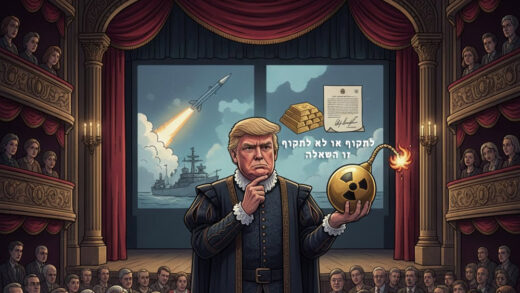
What They’re Selling Us in the Name of Peace, and Why Every Peace Deal Looks Like the Trailer for the Next War


A Sober Look at the Sacred Cult of the “Peace Agreement”
Every few years, like clockwork, a familiar figure appears on the global stage.
Silver hair. A Nobel Prize warming up in the back pocket. A dove pinned neatly to the lapel.
With solemn confidence, he declares: “Peace in our time.”


The media applauds.
The left sings hymns.
News anchors stand at attention as if it’s Memorial Day – except no one mentions that what usually follows is not calm, but blood, fire, and another season of sirens.
Because what exactly is a “peace agreement” in the Middle East?
It’s the European fantasy photocopied onto a region that never asked for it.
A belief that there are no enemies here – only misunderstandings.
That centuries of tribal conflict, religious absolutism, and genocidal ideology can be resolved with hugs, kisses, and 300 pages of legal clauses the other side has no intention of honoring.
Peace agreements, in this vision, are contracts with a reality that does not exist.
Paper attempts to sketch a world that refuses to be born.
And paper, as always, tolerates everything.
Every Peace Agreement Is Basically a Ceasefire with Better PR
Let’s start with facts – an endangered species in peace conferences.
Oslo did not bring peace.
It brought stabbings to Jerusalem, suicide bombers to buses, and Yasser Arafat back to Ramallah with black fatigues and a renewed sense of mission.
The so-called peace arrangement with Lebanon in the 1980s collapsed in under a week – but who’s counting.
The disengagement from Gaza – marketed not as a peace deal but as a “brave unilateral step” – did not produce postcards of coexistence. It produced rockets. First on Sderot. Then Ashkelon. Eventually Tel Aviv.
And if we go further back – yes, Egypt.
The famous “cold peace.”
Freeze-dried. Vacuum-sealed.
As long as Washington wires the checks, peace holds.
The day the money stops? Camp David’s paper will burn nicely alongside embassy flags.
So What Are They Really Selling Us?
Hope.
Vague, poetic, cosmic hope.
Peace is not a goal anymore – it’s a brand.
A comforting word that wraps reality so we can pretend we’re not surrounded by enemies, but by “potential partners.”
It’s a marketing mechanism.
For media outlets chasing moral relevance.
For governments eager to look enlightened at the UN.
For political consultants with their eyes on Stockholm, not Sderot.
The problem with selling illusions is that you have to keep refreshing them.
So we get a new agreement.
Another ceremony.
Another handshake with a smiling terrorist in a suit.
And when it explodes – literally – we’re told the problem wasn’t the concept.
We just didn’t try hard enough.
Translation:
We bought an iPhone without a battery. It didn’t work.
So obviously, we should buy it again – this time without a camera.
Peace as a Launchpad for War
Real peace agreements are signed between winners and losers.
Germany didn’t negotiate “mutual narratives” after World War II.
It surrendered. It complied. It was rebuilt under strict conditions.
In Israel, we do the opposite.
We sign peace deals with enemies who didn’t lose.
Sometimes with enemies who actually won the narrative war.
We give land.
Weapons.
Electricity.
Water.
And most importantly – legitimacy.
In return, we get a signature from someone who barely controls his own village.
This creates a perfect paradox:
The other side smells weakness.
They rearm.
They reorganize.
They attack.
Because to them, a peace agreement is not an end of conflict – it’s a timeout.
Hamas used it that way after disengagement.
The Palestinian Authority used it after Oslo.
And let’s be honest: Iran would use it exactly the same way if we ever signed a “nuclear peace deal” in the spirit of the Obama era.
Why Do We Fall for It Every Time?
Because we’re a post-exilic people with a deep need to believe the world will eventually “come to its senses.”
Because we want to be liked.
Because we crave membership in the enlightened European club – despite living in the middle of a Middle Eastern jungle.
So every time a new American president delivers a speech about hope, someone here inevitably says:
“Maybe this time it’ll work.”
It won’t.
Not in a reality where Hamas educates children to murder Jews.
Not when Iran openly dreams of wiping us off the map.
Not when large parts of the Arab world still view Zionism as a historical defect.
Conclusion: “Peace Agreement” Is Often Code for a Break from Responsibility
The problem is not peace.
The problem is the naïve belief that an agreement creates peace.
You don’t make peace with enemies who want peace.
You make peace with enemies who have stopped being enemies.
Until then, maybe it’s time to change the record.
Peace is made with sticks – not only with carrots tied in decorative ribbons.
If someone truly wants peace, let them bring quiet – not certificates.
Because right now, every peace agreement looks less like a solution and more like the opening credits of the next episode in an all-too-familiar series:
“Another War. Another Shock. And a Brand-New Peace Deal – Now on Sale.”
הירשמו כדי לקבל את הפוסטים האחרונים אל המייל שלכם