
When “Zionism” Has Become a Curse Word in Philosophy Halls?


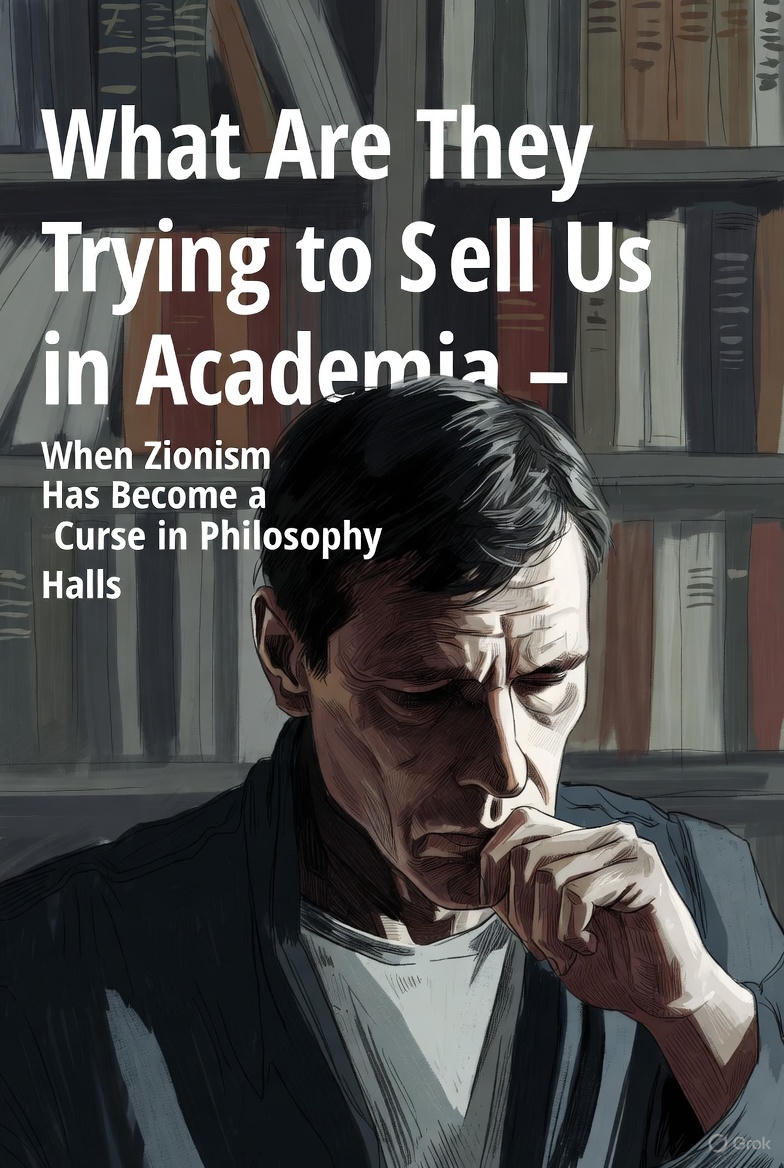
What Are They Trying to Sell Us in the Academy
How a people who gave the world ethics, justice and monotheism became “problematic” in Intro to Critical Theory.


If you haven’t visited a university campus lately, let me save you the trip.
Imagine a room where everyone is reading the same four theorists, wearing the same square glasses, and whispering the word “nation” as if it’s a contagious disease caught by saying it aloud.
 And the greatest academic sin of all?
Eating gluten?
No.
Declaring – heaven forbid – that you are a Zionist.
Or worse: a Zionist who is not ashamed of it.
Once upon a time, philosophy departments wrestled with humanity’s biggest questions:
What is truth? What is existence? How should humans live?
Today the questions are more logistical:
- Which professor cancelled class again for another activism-themed conference?
- Who’s in charge of drafting this week’s condemnation of Israel?
- And how do you phrase “I don’t hate my own country” in academic language without ruining your GPA?
Ladies and gentlemen – welcome to the Academy of 2025.
Where logic is an elective, but identity politics is mandatory.
The Modern University: Where Students Don’t Learn to Think – They Learn to Apologize
Yes, universities are supposed to teach critical thinking.
But “critical” has been downgraded to a very narrow definition:
Criticize Israel.
Everything else is optional.
Zionism?
It’s spoken the way medieval monks whispered the names of demons.
If a brave soul dares to say “I’m pro-Israel,” they immediately add a long list of apologetic footnotes:
“I mean, I obviously acknowledge the complexities, and I’m aware of the power dynamics, and I don’t endorse any oppressive colonial hegemonic structures-”
Relax.
You just said your grandparents survived pogroms.
Students quickly learn the three cardinal rules of campus survival:
- Don’t say “Zionist.”
- Don’t imply that Israel might not be the villain in every known universe.
- Don’t ask why the timeline of global colonialism apparently starts in 1948 and not, say… with the British Empire, the Romans, the Ottomans, the French, the Spanish, the Assyrians, the Babylonians, or any civilization ever.
But who cares, right?
As long as the professor gets another grant for research on “Colonial Echoes in the Semiotics of Palestinian Falafel,” everything is fine.
So What Are They Really Selling?
 Knowledge?
Wisdom?
Intellectual courage?
Don’t be silly.
The modern academy sells guilt.
Guilt is the campus currency.
Didn’t read the assigned text? Compensate with guilt.
Didn’t understand the lecture? Compensate with guilt.
Don’t think Israel is a cartoon supervillain? Double guilt.
Identity politics provides the spice:
If you grew up in a functioning country with buses and electricity, you’re automatically disqualified from participating in “authentic pain.”
And if you’re Jewish – forget it entirely.
Your historical suffering counts only when it’s convenient for an activist’s presentation.
Zionism?
It’s viewed not as a liberation movement, but as… a bad vibe.
Something that disrupts the fragile ecosystem of campus virtue signaling.
Let’s Be Honest: Why Do They Hate Zionism So Much?
Because Zionism complicates the narrative.
It’s much easier to teach that one side is eternally oppressed and the other eternally evil.
But Zionism ruins the script:
A stateless, persecuted people returns to its homeland after two thousand years – and survives.
How do you fit that into a PowerPoint about colonialism?
You don’t.
So the academy simply rewrites the definitions and hopes no one notices.
To admit Zionism is legitimate would require acknowledging that Jews have agency, identity, history – and a right to live.
And that’s inconvenient.
Academic discomfort level: nuclear.
Professors: Terrified of Students, Budgets, and Each Other
 The average professor in 2025 knows better than to touch certain topics.
Why?
Because:
- A harmless pro-Israel comment = departmental headache
- Radical students with iPhones = real threat
- Tenure committees = no mercy
So professors adapt.
They play the game.
They say the “right” things:
- Criticism of Israel – encouraged
- Criticism of Palestinians – forbidden
- Criticism of academia itself – suicidal
Which is hilarious when you think about it.
These are people who dedicate their lives to studying Kant, Foucault and Derrida – but can’t handle a student who says:
“Maybe Israel isn’t a colonial empire the size of Nevada.”
Students: Masters of ‘Appearing Woke,’ Not of Thinking Deeply
Students today aren’t dumb – far from it.
But many have mastered the art of sounding enlightened without saying anything of substance.
They know that writing “this text reinforces hegemonic structures” gets a higher grade than actually understanding it.
Why study logic
when you can throw around the phrase
“violence embedded in the discourse of the space”
and impress your professor?
Posting an angry tweet about the Israeli flag counts as political consciousness.
Reading a book?
Optional.
The academy has become a high-efficiency washing machine for ideological uniformity, producing graduates who are “critically aware” but can’t explain why Copernicus mattered.
So What Are We Left With?
The academy will keep operating – it always does.
It will continue to publish unread articles, hold conferences no one understands, and congratulate itself for dismantling imaginary empires.
But outside campus walls, in the real world, people still know a basic truth:
Zionism is not a curse.
It’s the reason Israel exists at all.
Not as theory, not as narrative – but as fact.
A stubborn, miraculous fact:
A tiny people returned home after two millennia while half the world told them it was impossible.
If that’s “colonialism,”
then colonialism needs a new dictionary.
The academy can twist itself into philosophical pretzels.
It can debate the “deconstruction of Jewish identity.”
It can elevate jargon to an Olympic sport.
But no academic jargon can erase the simplest philosophical statement ever written:
“The Jewish people lives.”
If that’s a curse word in today’s philosophy halls –
they can keep their halls.
We’ll keep reality.
הירשמו כדי לקבל את הפוסטים האחרונים אל המייל שלכם