A Nation of Sirens

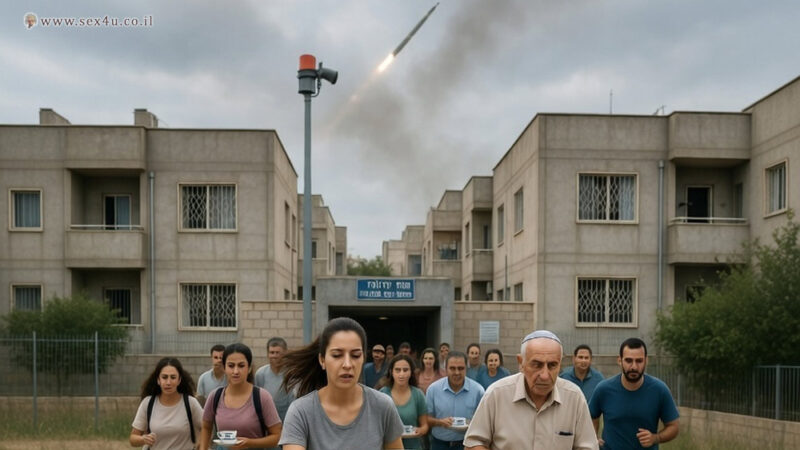
A slightly cynical tribute to the people who can run to a shelter without spilling their coffee
Some nations measure courage through epic wars, legendary battles, or speeches that echo through history books.


And then there is one small nation in the Middle East that measures courage by something far more mundane: managing to reach the safe room in time, closing the window before the shockwave, and returning ten minutes later to check whether the pizza in the oven survived the incident.
That, in short, is the story of the people of Zion.
For decades, Israeli civilians have lived inside a reality that most countries would describe as an “extreme emergency scenario.” Here it is simply another weekday.
Sirens.
A quick descent to the shelter.
A glance at Telegram and the Home Front alert app.
And then back to normal life.
All while the rest of the world looks on in mild confusion, wondering how such a routine can possibly be considered routine.
The Culture of the Safe Room
Israelis rarely think about it anymore, but one of the country’s most quietly ingenious inventions is the residential safe room.
Known locally as a mamad, it is essentially a reinforced concrete chamber built into modern apartments. Officially, its purpose is to protect civilians from missile attacks.
Unofficially, it doubles as an office, a children’s playroom, a storage unit, a laundry room, and occasionally the place where you sit with your laptop hoping the siren will not interrupt a Zoom meeting.
The idea may seem mundane today, but its origins go back to the Gulf War in 1991, when Iraqi Scud missile attacks sent an entire country scrambling for gas masks and sealed rooms.
Since then, the safe room has become an inseparable feature of Israeli architecture.
In other countries, people build wine cellars.
In Israel, people build concrete boxes designed to survive missile strikes.
Every culture has its hobbies.
The Psychology of the Siren
Perhaps the strangest aspect of the Israeli story is not the rockets.
It is the adaptation.
A typical citizen in a peaceful country might hear an air raid siren once in their lifetime. They would likely remember it forever.
An Israeli hears sirens roughly the way people elsewhere hear smartphone notifications.
The usual response ranges somewhere between:
“Oh come on, right now?”
and
“Alright, I still have thirty seconds to finish my coffee.”
There is even an unofficial scale of urgency depending on geography.
In southern Israel, you quickly check whether there is time to grab the dog.
In central Israel, you debate whether to bring the phone charger.
This is not courage in the cinematic sense.
It is something far stranger.
Habit.
The National Start-Up: Living Under Rockets
If there is one thing Israelis do exceptionally well, it is taking existential problems and turning them into engineering projects.
Which brings us to one of the most remarkable technological systems of modern warfare: Iron Dome.
Developed by Rafael Advanced Defense Systems, the system intercepts short-range rockets before they reach populated areas.
The operational logic is elegantly simple:
Rocket launched → radar detects → interceptor missile fired → explosion in the sky → the public returns to scrolling social media.
At times it even gives the impression that war has turned into an unscheduled fireworks display.
Of course, behind that spectacle lies a far more complex reality.
The Friendly Neighbors
Rocket barrages targeting Israel come from a variety of actors: Hamas, Hezbollah, the Houthi movement, and ultimately the strategic patron of several of these groups – the Islamic Republic of Iran.
Their method is relatively simple: fire rockets at civilian population centers in hopes of disrupting daily life.
It is not a particularly sophisticated military strategy.
It is a psychological one.
The goal is to produce fear, pressure, and eventually exhaustion.
There is, however, one small flaw in the plan.
It collides with a deeply rooted Israeli characteristic: stubbornness.
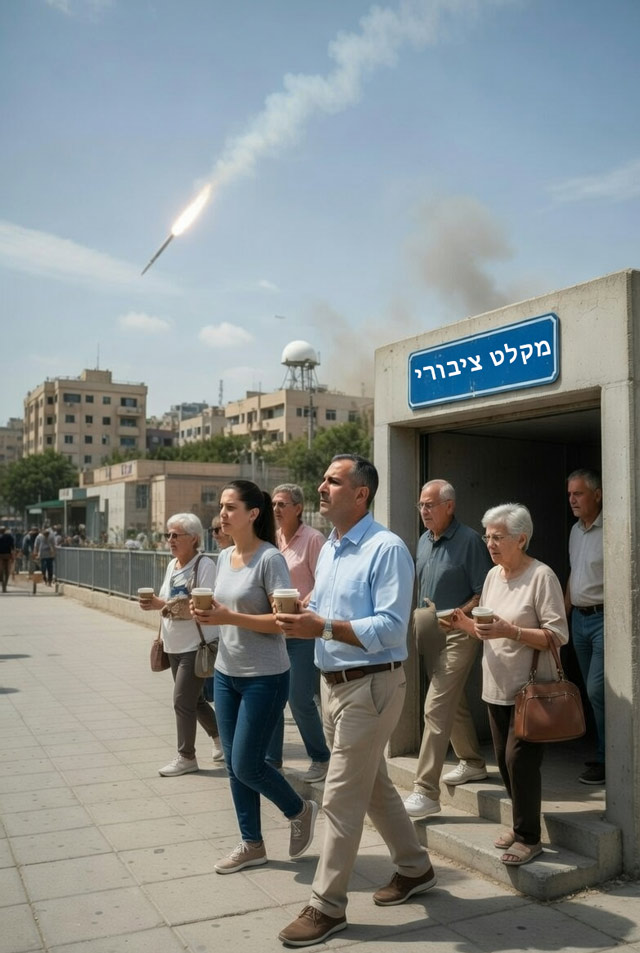
National Stubbornness
If one trait defines Israeli society, it is the remarkable ability to carry on.
A siren at three in the morning?
Fine. There is work tomorrow.
A rocket barrage during a football match?
Alright, we will pause for ten minutes and then resume the second half.
Over time this reality creates something unusual: a kind of cultural resilience.
Not perfect immunity.
But enough to maintain a functioning society.
In practical terms, life in Israel follows a simple rule:
If there is no siren at this exact moment, life continues.
Life Between Sirens
Daily life during periods of escalation follows a curious rhythm.
Morning: the news.
Afternoon: work.
Evening: a siren.
Night: arguments on social media about who is responsible.
And in between all of that, people do what people everywhere do.
They work.
They study.
They get married.
They raise children.
Which may be the most remarkable aspect of the story.
Despite everything, life continues.
The Sociology of the Shelter
Public shelters are fascinating places from an anthropological perspective.
For a few minutes, Israeli society gathers in a confined space and briefly drops its usual social barriers.
You will see everything there.
The neighbor who constantly complains about the building committee.
The kid who brought a tablet.
The grandmother distributing cookies.
And somewhere in the middle of the room, the classic national debate begins:
“Was that an interception or an impact?”
It is a small conversation, but it reflects something larger.
An attempt to transform a stressful situation into an ordinary social moment.
Humor as a Defense System
One of the most important coping mechanisms Israelis have developed is humor.
Jokes about sirens, rockets and safe rooms appear almost immediately after each round of escalation.
This humor is not indifference.
It is a form of psychological armor.
When a frightening reality becomes the subject of jokes, it loses some of its power to intimidate.
So Why Does It Work?
The larger question is how an entire society manages to live like this for decades.
The answer lies in a combination of factors:
A long historical experience with security threats.
A highly developed civil defense system.
A relatively strong sense of social solidarity.
And an unusually healthy dose of cynicism.
That cynicism may well be the Israelis’ secret weapon.
So What Is the Real Story?
Ultimately, the story of Israel is not only a story about rockets and conflict.
It is also a story about a society that refuses to panic.
Yes, there is fear.
Yes, there is stress.
Yes, there are sleepless nights.
But there is also something else.
The determination to continue.
To drink coffee.
To go to work.
To send children to school.
And sometimes, when the siren sounds right in the middle of all that, simply pick up the coffee cup, walk into the safe room, and continue the conversation from there.
Because if there is one thing that can be said about the people of Zion, it is this:
They may not have chosen this reality.
But they have certainly learned how to live with it.
And if they must live with it, they might as well do it with a little humor.
הירשמו כדי לקבל את הפוסטים האחרונים אל המייל שלכם