
Antisemitism 2.0: How Algorithms Accidentally Discovered They Hate Jews


Twenty-first-century antisemitism doesn’t march in the streets.
It doesn’t wear uniforms.
It doesn’t hand out leaflets.


It likes.
It shares.
It gets pushed to your feed.
Welcome to the age where hatred no longer needs ideology, manifestos, or a funny mustache.
All it needs is a decent algorithm, a bit of outrage, and a population glued to their screens.
The Algorithm: Not Antisemitic, Just “Engagement-Driven”
Let’s be clear from the start.
The algorithm does not hate Jews.
It’s worse than that.
It’s stupid.
And stupidity, as history keeps reminding us, is fertile ground for evil.
The algorithm doesn’t ask whether content is true, false, inciting, or recycled blood libel.
It asks one question only:
Does this perform?
“Perform” means:
Does it trigger anger?
Does it provoke outrage?
Does it generate emotional reactions?
And here comes the uncomfortable truth: antisemitism has always performed exceptionally well.
Why Jews? Because the Brand Is Familiar
Antisemitism is the oldest virus on the shelf.
It comes with ready-made narratives, recognizable villains, and a conspiracy library richer than Netflix.
When someone posts “Jews control the media”,
the algorithm doesn’t think:
“Ah, a medieval myth from the 14th century”.
It thinks:
“Wow, 12,000 comments in an hour. Push this harder”.
History? Context? Responsibility?
Not included in this update.
Antisemitism Without Antisemites
The great innovation of the 21st century is that you can spread antisemitism without being antisemitic. At least not officially.
You’re just “asking questions”.
Just “criticizing Israel”.
Just “challenging dominant narratives”.
Just “offering another perspective”.
The algorithm loves this stuff.
Rhetorical questions are recommendation-system pornography.
And so we get the absurd situation where people who’ve never met a Jew,
never opened a history book,
and couldn’t find Israel on a map,
are convinced they’ve uncovered a global conspiracy.
Because the algorithm told them it matters.
What Used to Be Fringe Is Now Viral
Once upon a time, antisemitism lived on the margins.
In obscure newspapers.
In closed circles.
In shady back rooms.
Today?
It comes with aesthetic filters, dramatic music, and subtitles.
TikTok, Instagram, YouTube – the platform barely matters.
What matters is that it’s short, sharp, and framed as forbidden knowledge.
“What they don’t tell you about the Jews.”
“Who really profits from wars.”
“Follow the money.”
Three minutes. Zero facts. A million views.
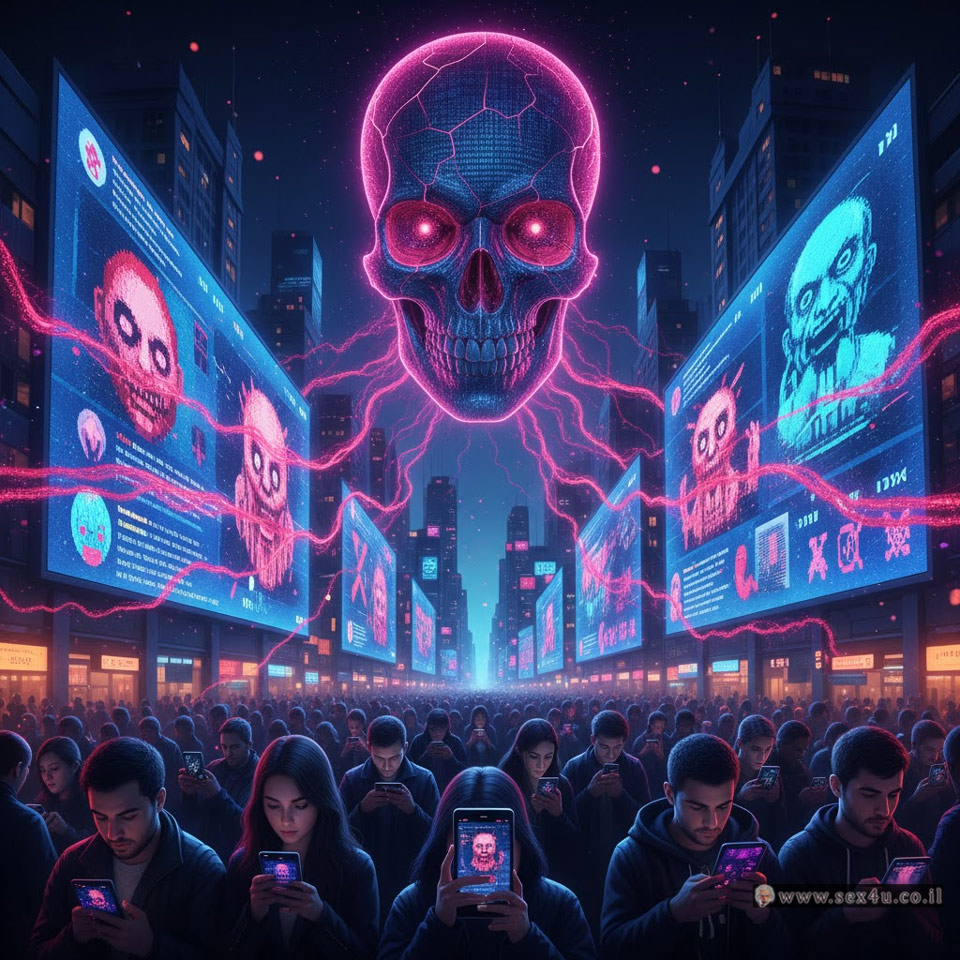
The Algorithm Loves Victims – and Hates Complexity
Digital culture thrives on simple stories:
Good versus evil.
Oppressor versus oppressed.
Victim versus villain.
Jews, inconveniently, don’t fit neatly into this structure.
Too much history.
Too many facts.
Too many contradictions.
So the algorithm simplifies.
It erases nuance.
It leaves an image.
The Jew stops being a person and becomes a symbol.
A human story turns into a convenient target.
Israel: Built-In Antisemitic Bonus Content
This is where the algorithm really has fun.
Israel is Jewish, sovereign, armed, and extremely photogenic.
A perfect storm.
Every half-edited video,
every image stripped of context,
every furious headline
gets an automatic boost.
Not because it’s accurate.
Because it works.
And the world?
The world scrolls.
Why This Is More Dangerous Than Before
Because this time, there is no center.
No editor.
No accountability.
Hatred doesn’t flow top-down.
It spreads horizontally – through friends, families, group chats.
And worst of all?
It arrives wrapped in moral language.
Antisemitism disguised as social justice.
As punching up.
As progress.
The algorithm loves that.
It gives hatred a moral certificate.
So What Can Be Done?
Honestly?
Not much at the system level.
The algorithm won’t study history.
It won’t feel shame.
And it won’t apologize.
People, however, still can.
Pause before sharing.
Notice when criticism turns into obsession.
Understand that virality is not truth – it’s a symptom.
And above all, remember this:
If a piece of content makes you instantly furious at an entire group of people –
that’s not insight.
That’s manipulation.
In Conclusion – No Filters
Antisemitism in the 21st century doesn’t look like it used to.
And that’s exactly the problem.
It’s faster.
Smoother.
Algorithmically optimized.
The algorithm doesn’t hate Jews.
It just amplifies whatever is ugly, as long as it generates traffic.
And hatred?
It’s learned the rules of the game very well.

הירשמו כדי לקבל את הפוסטים האחרונים אל המייל שלכם