Israel-Uganda Relations

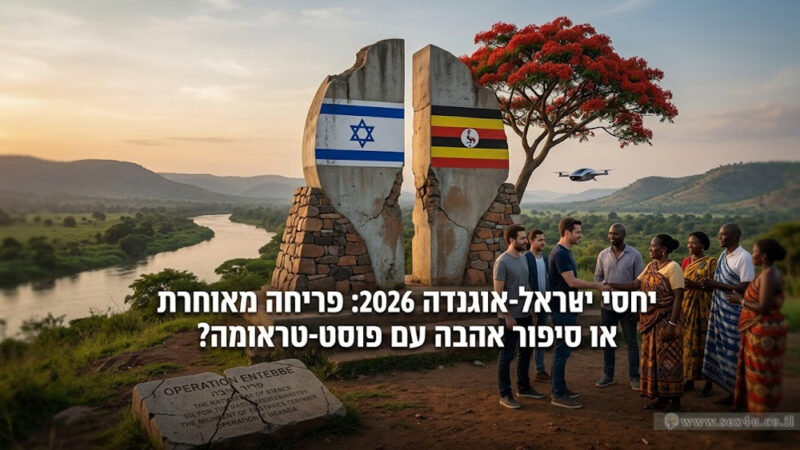
Israel-Uganda Relations in 2026: A Late Bloom or a Strategic Rebound?
There are international relationships that look like contracts. Others look like transactions.
And then there’s the story of Israel and Uganda – which, in 2026, looks suspiciously like a former couple getting back together after a very public, very awkward breakup… with a bit more military hardware and a lot less emotional honesty.


Because let’s be clear: when a senior African military figure starts tweeting pro-Israel messages that sound like they were drafted in Tel Aviv – something unusual is happening.
The Unexpected Romance: When a General Goes All In
If 2026 had a geopolitical surprise category, Uganda’s military leadership would be a strong contender.
General Muhoozi Kainerugaba, Uganda’s army chief and son of the president, didn’t settle for polite diplomacy. He went full declaration mode:
“Any talk of destroying Israel will bring us into the war – on the side of Israel.”
-- פרסומת --
And just in case that sounded ambiguous (it didn’t), he doubled down:
“Israel supported us… now we stand with them.”
That’s not diplomatic language. That’s loyalty – or at least the performance of it.
In a world where most countries hedge their bets, Uganda suddenly sounds like the one friend who shows up uninvited but insists on paying for dinner.
A Statue in Entebbe: When History Gets Rewritten in Bronze
If the rhetoric raised eyebrows, the symbolism sealed the deal.
Ugandan officials announced plans to erect a statue of Yonatan Netanyahu at Entebbe – the Israeli commander killed during the famous 1976 rescue operation.
Let’s pause on that.
A country plans to honor, with a statue, the commander of a foreign force that conducted a military operation on its soil.
That’s not just unusual – it’s borderline surreal.
Netanyahu, who led the raid during Operation Entebbe, became a national symbol in Israel. Now, decades later, Uganda is turning him into a symbol of something else entirely: reconciliation, admiration, or perhaps strategic messaging dressed as historical reflection.
It’s the kind of move that makes you wonder whether history is being remembered – or repurposed.
A Brief History: From Partnership to Breakdown and Back
To understand how strange this is, you need context.

The 1960s-early 1970s: The Honeymoon
Israel and Uganda enjoyed close ties. Israel provided military training, infrastructure support, and technical assistance. Uganda, in return, offered a foothold in East Africa.
It was cooperation, plain and simple.
The Idi Amin Era: The Collapse
Then came Idi Amin.
Relations deteriorated rapidly. Uganda pivoted toward Libya, the Soviet bloc, and anti-Israel positions. What was once partnership turned into hostility.
1976: Operation Entebbe
A hijacked Air France flight lands in Entebbe. Israel launches a daring rescue mission. Hostages are freed. Yonatan Netanyahu is killed.
Israel wins the operation. Uganda loses face.
And history, for decades, remembers it that way.
2026: The Narrative Flips
Fast forward to today, and the tone is radically different.
Ugandan leadership now speaks of “blood relations” with Israel – a phrase that would have sounded absurd just a generation ago.
But this isn’t about rewriting history out of sentiment. It’s about reframing it for present needs.
Because beneath the dramatic gestures lie very real interests.
Why Now? The Real Drivers
Strip away the rhetoric, and the logic becomes clearer.
1. Security and Military Cooperation
Israel offers advanced defense technology, intelligence capabilities, and counterterrorism expertise.
Uganda offers geography – strategic positioning in East Africa – and a willingness to cooperate openly.
That’s not romance. That’s alignment.
2. Religion and Identity
Uganda has a large Christian population, and pro-Israel sentiment is often framed in religious terms.
Statements linking support for Israel to Christian identity are not unusual – and they resonate domestically.
3. Internal Politics
General Kainerugaba is not just a military figure; he is widely seen as a potential future leader.
Strong, visible international alliances – especially with a country like Israel – signal strength, independence, and global relevance.
In other words, this is as much about Kampala as it is about Jerusalem.
Is This Love – or Just Good Strategy?
Let’s not get carried away.
There’s no sudden emotional awakening between the two nations. There’s no collective forgetting of the past.
What there is:
- Mutual benefit
- Strategic calculation
- Carefully curated symbolism
Uganda hasn’t forgotten 1976.
Israel hasn’t forgotten Idi Amin.
But both sides have decided that the future is more useful than the past.
The Broader Context: Israel in Africa
Uganda is not an isolated case.
In recent years, Israel has been actively rebuilding and expanding its presence in Africa:
- Agricultural technology exports
- Security partnerships
- Diplomatic outreach
Uganda, in this context, is simply one of the more vocal – and perhaps more enthusiastic – participants.
Most countries pursue similar interests quietly. Uganda does it with headlines.

The Satirical Edge: When Reality Outruns Irony
There’s something almost comical about the entire situation:
- A country once embarrassed by a military operation now honors its commander
- A general tweets like a brand ambassador
- Historical conflict gets rebranded as “shared blood”
If this were fiction, it would be dismissed as unrealistic.
But geopolitics has a habit of making satire redundant.
So, Is This a “Late Bloom”?
Yes – but not in the romantic sense.
This is not a rediscovered friendship.
It’s a recalibrated relationship.
The kind that emerges when both sides look at the map, the numbers, and the risks – and decide cooperation makes more sense than distance.
The Bottom Line
Israel-Uganda relations in 2026 are not a miracle.
They are not ideological.
And they are certainly not sentimental.
They are a reminder of a simple rule:
In international politics, even the most complicated histories can be repurposed –
if both sides have something to gain.
And somewhere in Entebbe, as a statue of Yonatan Netanyahu takes shape, that message becomes impossible to miss:
Sometimes, the best way to move forward…
is to turn yesterday’s conflict into today’s alliance.
הירשמו כדי לקבל את הפוסטים האחרונים אל המייל שלכם
Discover more from Intelligent is sexy
הירשמו כדי לקבל את הפוסטים האחרונים אל המייל שלכם