
The People Voted – The Supreme Court Overruled: How Israel’s Democracy Became a Branch Office of the High Court

Where Does the Egg End and the Judge Begin?
There was a time when judges sat high up in Jerusalem — cloaked, distant, and summoned only when the Devil himself wanted to appeal a parking ticket.
These days, it feels like they’ve moved right into our living room.
Every government decision? Supreme Court.
Every law passed by the majority in the Knesset? Supreme Court.
Every ministerial order? Supreme Court.
At this rate, they’ll soon be striking down restaurant menus for “excessive use of parsley.”


Let’s not kid ourselves — this isn’t judicial review anymore. It’s an alternative government: unelected, unaccountable, and overly adored by the media.
Rule of the People or Rule of the Court – Pick One
The foundation of any democracy is simple: the people are sovereign.
But in Israel, the moment the people vote a little too far “to the right,” the Court swings its gavel and puts the nation “back on track” — its track.
A right-wing elected official? “Unreasonable.”
A law passed by majority vote? “Unconstitutional” — based on a constitution that doesn’t even exist.
A minister chosen by public mandate? “Unfit.”
A government proposing judicial reform? “Impossible — it harms the justice system.”
Even my grandmother understands: this isn’t a judicial system anymore — it’s a ruling system.
Judicial Activism: The Problem Isn’t the Power – It’s the Arrogance
If it were just a question of overreach, we could live with it.
But the Court doesn’t just stretch its authority — it invents new ones on the fly.
When? Whenever convenient.
How? By quoting itself.
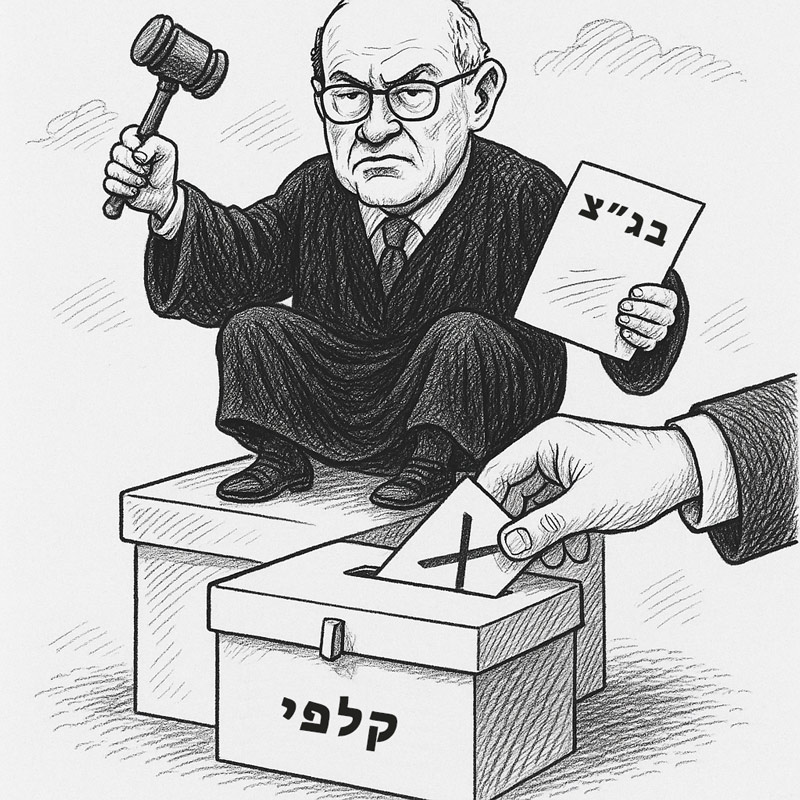 It’s like a kid playing backgammon alone, losing, then suddenly declaring: “Double sixes mean I win automatically.”
We’ve even seen it happen: the Knesset passes a new Basic Law — and suddenly the Court decides to review whether that Basic Law is constitutional.
Yes, you read that right — a constitutional review of a constitution-equivalent law. That’s not legal brilliance; that’s judicial acrobatics.
The Supremacy of the Jurists – The Core Principle of a “Jurisocracy”
In normal countries, courts interpret laws.
In Israel, they rewrite them.
Here, the Attorney General is not “legal adviser to the government,” but “the government’s legal boss.”
And that’s before we even mention the fact that judges hold veto power over the appointment of new judges.
This isn’t a system of checks and balances.
It’s a system with one check and total balance cancellation for anything remotely conservative.
Reform? The Court Will Strike It Down.
Criticism? The Court Will Be Outraged.
The People? The Court Will Replace Them.
When a right-wing government was democratically elected, the judicial system went into emergency mode.
Every action faced legal resistance.
When the government tried to pass a reform that would limit the Court’s ability to cancel Basic Laws, pundits screamed, “This is the end of democracy!”
Since then, it’s become a national sport: every government decision, even mid-level appointments, is filtered through the judiciary.
And what’s left of democracy? A nice PowerPoint presentation for Memorial Day ceremonies.
“But the Court Protects Democracy!”
Of course, that’s the classic argument of the legal elite:
“If not the Court, who will protect the minority?”
Well, in a real democracy there are many ways to protect minorities — legislation, education, public discourse, dedicated institutions — but not by trampling the will of the majority.
Not by serially striking down everything a handful of unelected judges dislike.
And let’s be honest — the Court doesn’t really protect all minorities.
Not settlers, not ultra-Orthodox, not Mizrahim, not traditional Jews.
It protects only the right kind of minorities.
When Judges Become Politicians, They Lose Their Moral Authority
The more the Supreme Court meddles in politics, the less the public sees it as neutral.
And rightly so.
A judge deciding whether Deri can serve, whether Ben-Gvir is “fit for office,” or whether the Nation-State Law is “constitutional” — that’s not a judge anymore.
That’s a politician in a robe.
And that’s fine — for politicians.
Not for judges.
In Conclusion: A Jewish and Democratic State – or the State of “Supreme Court and Haaretz”?
You can’t sustain a democracy where judges rule over the people instead of the people choosing their leaders.
You can’t function in a reality where every national initiative, every conservative reform, every law with a Jewish character — must pass through the filter of advisers, prosecutors, and finally, fifteen people who act like a supreme jury for a state whose flag they barely acknowledge.
If Israel wants to remain a living, breathing democracy, it must return public decisions to the public.
Not leave them in the hands of an unelected body that no one can replace — whose only limit is its own ego.
And if anyone at the Supreme Court finds this article offensive — don’t worry.
We’ll submit it for your approval.
You’ll probably find it… unreasonable. 😏
הירשמו כדי לקבל את הפוסטים האחרונים אל המייל שלכם