
Launches Toward the Center and the North

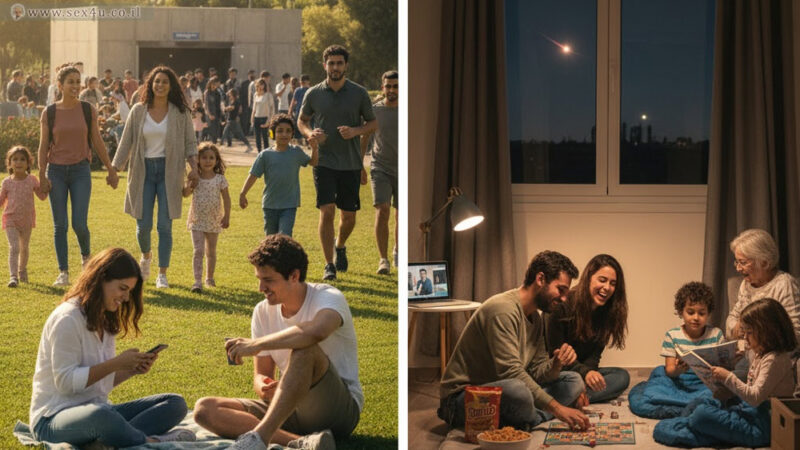
The Israeli Guide to Living Perfectly Normal Lives Under Air-Raid Sirens – March 2026
There are countries where a “news update” means a political scandal, a change in the weather, or a crucial football match.


In Israel, however, a news update often sounds something like this:
“Sirens in central Israel. Interceptions reported in the north. The public is advised to remain near protected spaces.”
And that is more or less the entire story.
Life goes on.
Taxi drivers continue arguing about politics. Traffic on the Ayalon Highway maintains its usual, reliable level of urban misery. And the most pressing debate in the office remains the same as always: who ordered sushi again without asking everyone else.
March 2026 is simply another small chapter in the long history of Israel’s routine under fire. Not a full-scale war, not genuine peace either – but that strange middle ground where missiles are almost part of the landscape.
And the truth is this: Israelis have already developed an entire operating system for living inside this situation.
The Siren: Israel’s National Alarm Clock
Every country has sounds that define an era.
Once it was the ringing of a landline telephone.
Then came the buzz of an SMS message.
Today?
The Red Alert siren.
It has become one of the most recognizable sounds in Israeli life. There is even a curious phenomenon: Israelis can identify that sound faster than any notification on their phones.
Within seconds an almost automatic process unfolds:
Heads turn toward the sky.
Someone asks, “Where was that?”
Someone else is already opening Telegram.
And the final stage – half the country checks the Home Front Command app.
All of this happens faster than it takes to boil a kettle.
National Survival Technology
Over the years Israel has developed a rare combination: cutting-edge technology paired with an ancient national talent for improvisation under pressure.
On one side there are sophisticated systems such as:
Iron Dome
Advanced warning networks
Emergency apps
Command centers monitoring every launch
On the other side are the public’s real solutions:
A stairwell.
A shared shelter from the 1970s.
A “protected room” that normally serves as a storage unit.
And the classic response: stepping into the bathroom and saying, “It’ll be fine.”
Some countries invest billions in bunkers.
Israel, for the most part, invests in a philosophical approach best translated as:
“Eh… it’ll probably work out.”
 Israeli Normality: A Fascinating Psychological Phenomenon
If a foreign psychologist landed in Israel in March 2026, they might struggle to understand the contradiction.
On one hand:
Sirens
Interceptions
Breaking news alerts
On the other:
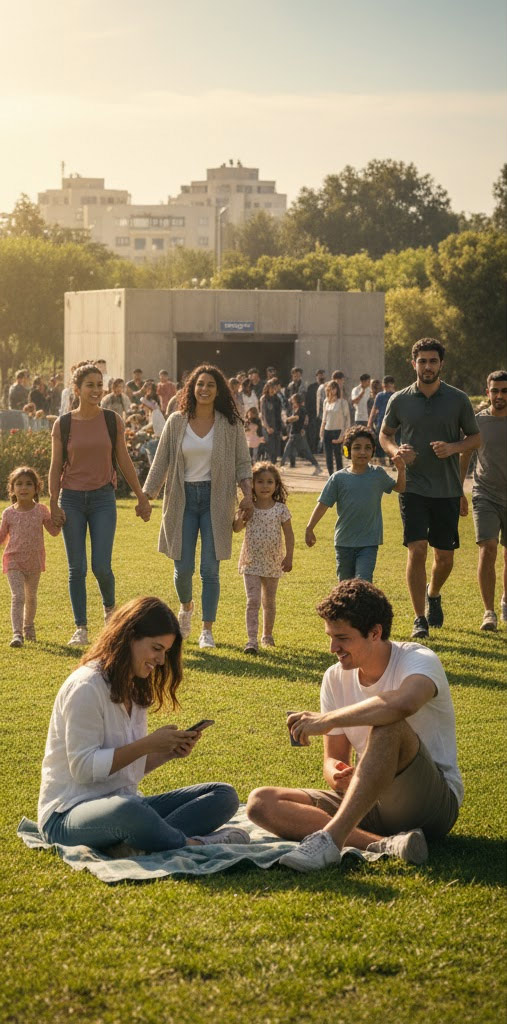
Packed cafés
Busy restaurants
Traffic jams that look like a national sport
And someone, somewhere, complaining about housing prices.
It is a nearly impossible contrast to explain.
In many countries a single air-raid siren could paralyze an entire city.
In Israel, however, a siren causes a brief interruption – and then life resumes.
Sometimes almost immediately.
The Shelter: The Strangest Social Club in the World
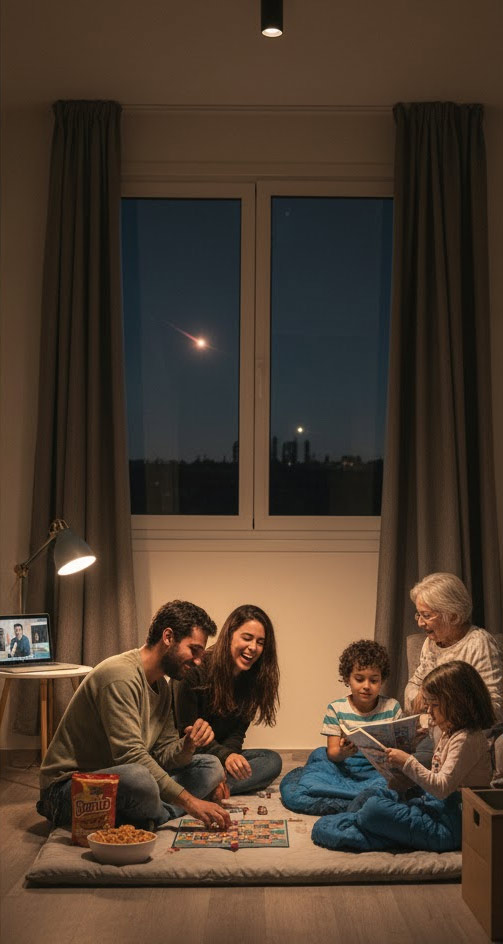
One of the unique features of Israel’s conflicts is the shared shelter.
It is a place where people who normally would not exchange a single word suddenly find themselves together:
The neighbor from the third floor.
The new family from the first floor.
The dog from across the hallway.
And someone who always brings a plastic chair as if this were a picnic.
In some shelters, deep philosophical conversations emerge.
In others, everyone simply stares at their phone.
And in rare cases, someone creates a new WhatsApp group called:
“Building 12 Shelter.”
Naturally, no one writes in it after two days.
The Economics of Sirens
One of the less discussed aspects of rocket fire is its economic impact.
Sirens do not only frighten people – they also disrupt the economy.
When entire neighborhoods head into shelters:
Businesses close temporarily.
Deliveries are delayed.
Public transportation pauses.
Employees abandon their desks.
On average, a day with frequent sirens in central Israel can cause tens of millions of shekels in economic losses.
Yet the Israeli economy has developed a certain resilience.
Many companies now operate with:
Remote work
Digital systems
Operational flexibility
Meaning that even when sirens sound, business does not necessarily stop.
 At least not entirely.
The Media: Between Drama and Routine
Israeli media faces an unusual dilemma.
On the one hand, every launch must be reported.
On the other hand, the public has already developed a certain emotional immunity to these reports.
The headlines sound dramatic:
“Rocket Fire Toward Central Israel”
“Interceptions in the North”
“Sirens Across Several Cities”
But within minutes people return to their daily routine.
In other words, in Israel even news about war eventually becomes background noise.
The New Generation: Children Growing Up With Sirens
Perhaps the most complex aspect of this reality concerns the younger generation.
Children in Israel grow up with concepts that in other countries sound like vocabulary from a war film:
Protected rooms
Interception systems
Emergency drills
Red Alert sirens
For them, it is not extraordinary.
It is simply part of life.
On one hand, this creates resilience.
On the other, it is a reality that no society would deliberately choose.
Yet, like many things in Israel, it has simply become normal.
Israeli Humor: A National Defense Mechanism
If there is one defining feature of Israeli society during conflict, it is humor.
Within minutes of a siren, social media fills with:
Memes
Jokes
Videos
And sarcastic comments
This does not come from insensitivity.
It is a survival mechanism.
When reality becomes too tense, sometimes the only way to cope with it is to laugh at it.
Life Goes On – Because It Must
The most common phrase heard in Israel during periods of tension is:
“Life goes on.”
And it does.
People go to work.
Children attend school.
Weddings take place.
Cafés remain full.
Not out of indifference, but out of a collective decision not to allow the security situation to dominate every moment of life.
It is a choice made by an entire society.
Israel 2026: A Country Learning to Live With the Abnormal
March 2026 is simply another reminder that Israel has spent decades living in a unique condition.
Not full-scale war.
Not genuine peace.
Something in between.
The routine of launches toward the center and the north is part of that reality – a reality where the threat exists, but life continues anyway.
The Cynical Conclusion
If Israelis have learned one lesson over the years, it is this:
Human beings can adapt to almost anything.
Even to things that should never feel normal.
Sirens, interceptions, and security alerts have become part of the soundtrack of life here.
And that may be the most Israeli phenomenon of all.
Not the politics.
Not the high-tech industry.
Not even the hummus.
But the strange ability to keep living normally –
Even when the sky occasionally decides to remind you that it is not entirely quiet.
הירשמו כדי לקבל את הפוסטים האחרונים אל המייל שלכם