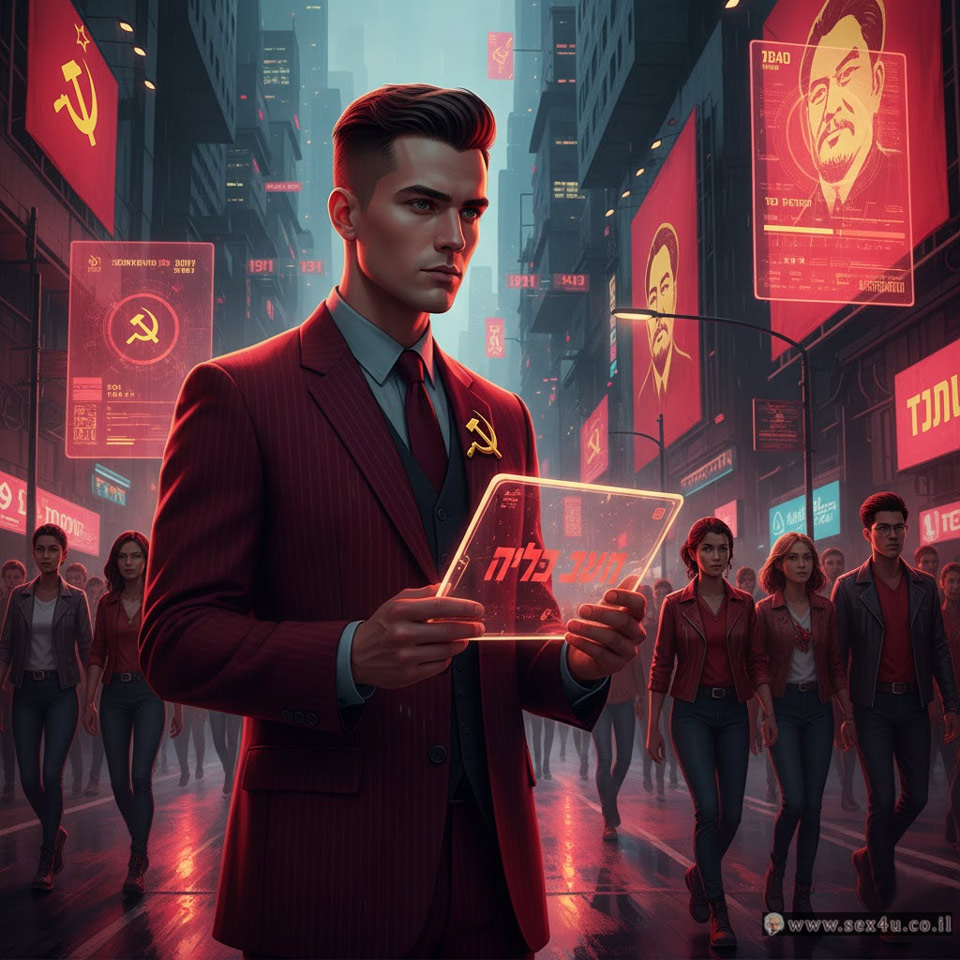
The Red Comeback

How Communism Rebranded Itself for the 21st Century
There was a time when being a communist required a thick mustache, a tractor in the background, and unshakable faith that a central planner knew better than a baker how much bread the neighborhood needed.


Today?
All you need is Wi-Fi.
Welcome to the most unexpected comeback since vinyl records: communism is back in the conversation. Not with tanks in Red Square, but with aesthetic infographics, viral threads, and minimalist podcasts explaining why “late-stage capitalism” is the real villain.
The hammer and sickle got a software update.
A Generation Without Memory – But With Bandwidth
Anyone born after the collapse of the Soviet Union has no lived memory of empty shelves, ration cards, or the subtle sport of whispering political jokes.
For them, communism exists as theory – clean, abstract, unbloodied.
A moral blueprint. A thought experiment. A corrective fantasy.
When you don’t remember the failure, you are free to romanticize the idea.
History becomes optional. Design is everything.
Capitalism Made One Fatal Mistake: It Succeeded Too Well
The modern revival of socialist thinking is not happening despite capitalism’s success – but because of it.
Global markets created unprecedented wealth. They also created staggering inequality.
Billionaires launching private rockets.
Young professionals unable to afford rent.
Tech monopolies with more influence than small countries.
When the system feels rigged, radical alternatives gain emotional traction.
And communism – or its softer, updated cousin – offers a simple narrative:
There are exploiters.
There are exploited.
We fix it by restructuring everything.
Clean. Moral. Shareable.
Communism 2.0 – No Gulags, Just Graphics
Today’s version rarely talks about dictatorship of the proletariat.
Instead, it champions:
- Student debt cancellation
- Universal basic income
- Aggressive wealth taxation
- Public housing expansion
- Breaking up tech monopolies
Individually, many of these ideas sound reasonable. Some are even pragmatic reforms.
But beneath the surface lies a familiar premise: the market cannot be trusted. The state must step in – decisively, expansively.
It is communism without uniforms.
Revolution without smoke.
Same core suspicion of private capital.
Better lighting.
The Incentive Problem That Never Went Away
 Communism has always struggled with one deceptively simple question:
If outcomes are equalized, what drives exceptional effort?
The standard response is noble: people are motivated by meaning, not just money.
True.
But incentives are not a capitalist conspiracy – they are human psychology.
Every historical attempt to suppress market signals eventually produced the same side effect: informal markets, corruption, black economies.
People want fairness.
They also want advantage.
That tension does not disappear because we rename the system.
The Romance of “It Wasn’t Real Communism”
Modern advocates often argue that past failures were distortions, not the true model.
“It wasn’t real communism.”
A fascinating defense – one that no other ideology enjoys with such persistence.
When capitalism fails, it is capitalism.
When communism fails, it was poorly implemented.
The Soviet Union. Mao’s China. Cuba. Venezuela.
Each experiment explained away as deviation.
And yet, in every case, central control over production and distribution created bottlenecks, inefficiencies, and power concentration.
Apparently, utopia just keeps being misunderstood.
Why Now?
Three forces are fueling the revival:
- Distrust of elites – political, financial, corporate.
- Economic anxiety – automation, housing crises, wage stagnation.
- Cultural shift toward moral absolutism – systemic narratives over incremental reform.
When trust erodes, reform feels inadequate.
Revolution feels honest.
And communism sells revolution in clean packaging.
Capitalism as Caricature
To be fair, modern capitalism is not innocent.
 Cronyism, regulatory capture, corporate consolidation – these distort markets and undermine legitimacy.
But the solution to distortion is often better competition and smarter regulation.
Not the abolition of markets altogether.
Reform is slow and boring.
Revolution is emotionally satisfying.
In the age of social media, guess which one spreads faster?
Campus Radicalism, Podcast Revolution
The new red revival is not emerging from factory floors.
It is emerging from lecture halls and long-form interviews.
Wrapped in academic vocabulary:
“Structural oppression.”
“Late capitalism.”
“Extractive systems.”
The language is sharp. The aesthetics are compelling.
But once the theory meets logistics – pricing, production, allocation – the old problems resurface.
Who decides what gets made?
At what price?
In what quantity?
Centralized answers historically created centralized power.
And centralized power rarely stays benevolent.
Not a Revolution – A Drift
Are we heading toward global communist regimes?
Unlikely.
What we are witnessing is subtler: ideological drift.
More state intervention.
More redistribution.
More suspicion of private accumulation.
Not a red flag over parliament – but a steady expansion of bureaucratic authority.
And over time, drift reshapes systems more quietly than revolutions ever did.
The Cynical Conclusion
Communism’s comeback is not about tractors or manifestos.
It is about emotion.
Fairness.
Belonging.
Moral clarity in a chaotic economy.
It thrives where inequality is visible and trust is fragile.
But history suggests something uncomfortable:
Grand promises collapse under practical execution.
Ideas glow in theory.
They flicker under implementation.
The 21st-century version may be softer, trendier, algorithm-friendly.
But the core dilemma remains unchanged:
How do you engineer equality without crushing initiative?
How do you centralize power without concentrating it?
How do you promise utopia without confronting human nature?
So no, the world is not turning red overnight.
But the red filter is back on the lens.
And this time, it comes with Wi-Fi.