Who are the Egyptians really?

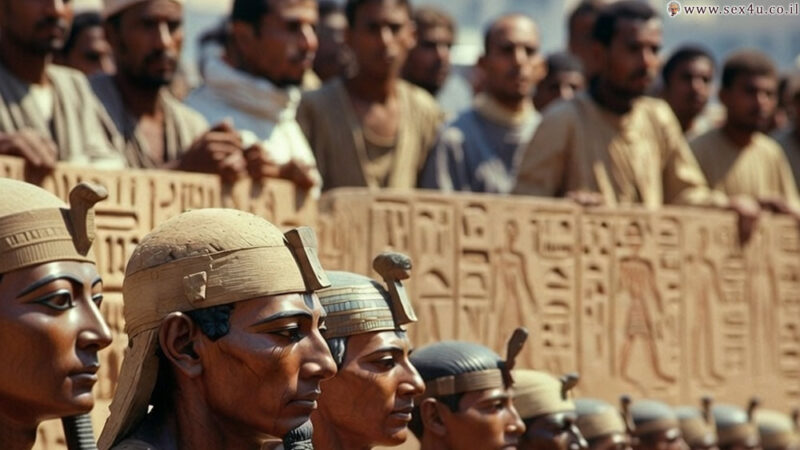
Between Pyramids and Paranoia: From a Glorious Past to a Confused Present


Some nations have a past.
Some nations have a present.
And then there are nations with a past so magnificent that the present lives in its shadow like a subtenant squatting inside an abandoned pyramid.
Egypt is exactly that.
On one side: one of the greatest civilizational projects in human history.
Writing. Architecture. Engineering. Centralized statehood. Religion. Mythology. Time. Death. Eternity.
On the other side: the Egyptian street of the 21st century – loud, frustrated, deeply suspicious, soaked in conspiracy theories, and firmly convinced that someone else is always to blame. Usually Jews. Zionists. The West. The CIA. The Mossad. Lizards. Or all of them together, working in shifts.
Which raises the uncomfortable question:
Is there any real connection between the people who built the pyramids and the people who believe Israel controls the weather and sends dolphins to spy on them?
Let’s talk seriously for a moment – about genetics and reality.
Less “golden headdresses”, more historical transit hub
Genetically speaking, the story of the modern Egyptian is far less “pyramids and golden robes” and far more “high-traffic historical crossroads with constant turnover”.
Research shows that ancient Egyptians were genetically much closer to ancient populations of the Near East – the Levant, Neolithic Anatolia, and their neighbors – and far less similar to what is commonly labeled today as “sub-Saharan Africa”.
Modern Egyptians, by contrast, carry a significant sub-Saharan genetic component. Significant enough to make the fantasy of a clean, unbroken biological line from pyramid builders to today’s Cairo taxi driver exactly that – a fantasy.
Where did this shift come from? Not from a curse of Ra, but from very earthly history.
The post-Roman period brought large-scale migration along the Nile, expansive trade networks, and above all, industrial-scale trans-Saharan slave trade. Over centuries – particularly during the second millennium CE – millions of enslaved Africans from south of the Sahara were brought into Egypt.
Add the Arab conquest of the 7th century, which introduced a strong Arab-Eurasian genetic component, and you get a genetic cocktail that looks nothing like what’s resting inside Ramses II’s mummy.
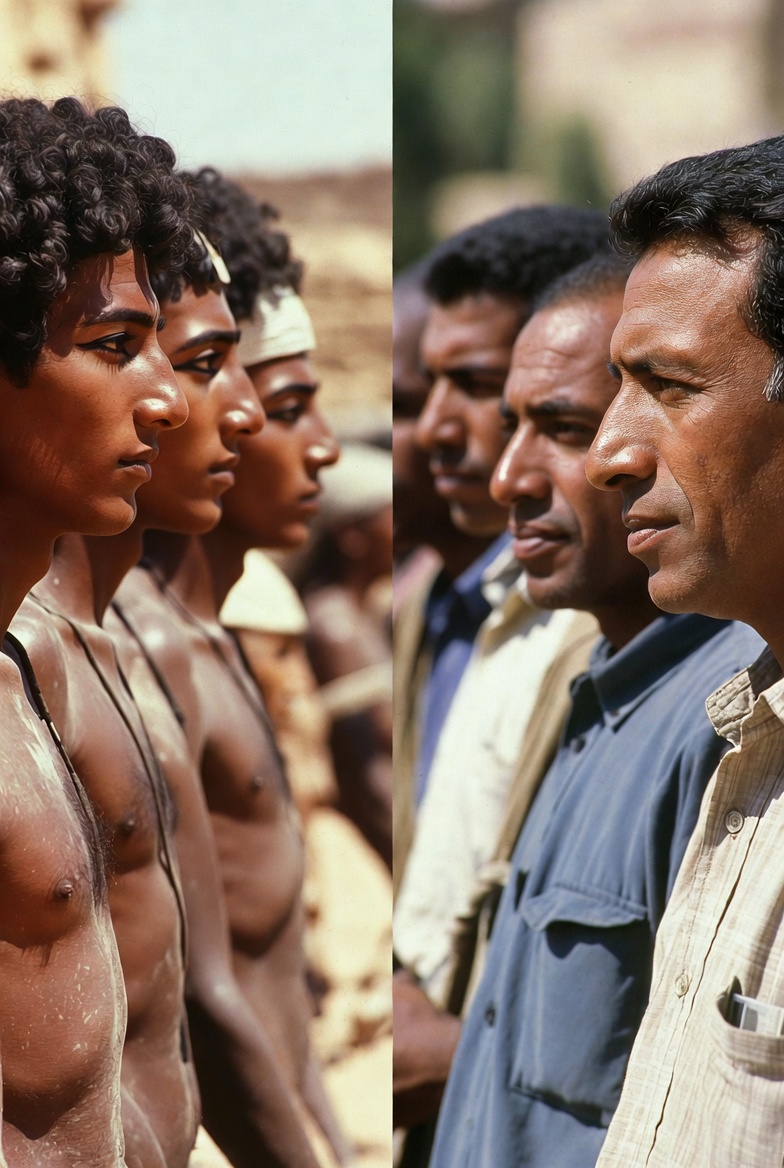
The result is simple and not particularly romantic: modern Egyptians are genetically closer to Arabs and sub-Saharan populations than to ancient pharaohs. There is no “pure pharaonic bloodline”, just a deep blend of conquerors, slaves, migrants, and traders – exactly what you’d expect from a region that served as a global crossroads for thousands of years.
The pharaohs stayed in stone, statues, and museums.
The genetics moved on. No nostalgia. No museum ticket required.
Ancient Egypt: when the world still made sense
Let’s start with the basics.
Ancient Egypt wasn’t just another culture. It was a complete operating system.
People knew who they were, what their role was, who stood above them, who stood below, and how the cosmic order worked.
The Nile rises – you sow.
The Nile falls – you harvest.
The pharaoh is divine – reality is clear.
There was no democracy, but there was stability.
There was no Twitter, which meant no 400 commentators screaming at the same time.
Above all, there was meaning.
Life was part of something larger – eternity itself.
Then came the present.
And it’s considerably less impressive.
The modern Egyptian did not build pyramids.
He did not design irrigation systems.
In most cases, he is fighting daily survival inside a massive, poor, centralized, corrupt state with a failing education system and a regime that prefers stability over thinking.
And when there is no horizon – people look for explanations.
When there are no explanations – they look for enemies.
When there are no convenient enemies – they invent them.
Conspiracy theories: the unofficial religion of the street
In Egypt, conspiracy is not a hobby. It’s a worldview.
Israel caused the Arab Spring.
Zionists collapsed the economy.
The West is stealing water from the Nile.
The Mossad is behind every terror attack – including those carried out by Egyptians.
This isn’t because Egyptians are stupid.
It’s because conspiracy is a perfect solution to a frustrating reality:
It explains everything.
It removes responsibility.
And it gives a sense of power: “I may be poor – but I know the truth”.
And the Jews? Always useful
In any culture struggling with identity, the Jew is a convenient character.
Not because he is truly powerful, but because he is symbolic.
A symbol of cunning. Hidden power. Modernity. Annoying success.
The average Egyptian on the street has never met a Jew.
But he has met videos.
TV series.
Hate sermons in mosques.
Endless political incitement.
School textbooks that haven’t been updated since 1967.
And hatred, like any low-quality product, gets passed down from generation to generation without quality control.
This isn’t genetics – it’s education (or the lack of it)
Let’s be very clear:
There is no “pharaonic blood” and no “conspiracy DNA”.
There is an education system that teaches memorization instead of thinking.
There is state media that prefers narrative over facts.
And there is a regime that understands a confused citizen is preferable to a critical one.
When people aren’t taught to ask questions, they believe the loudest answers.
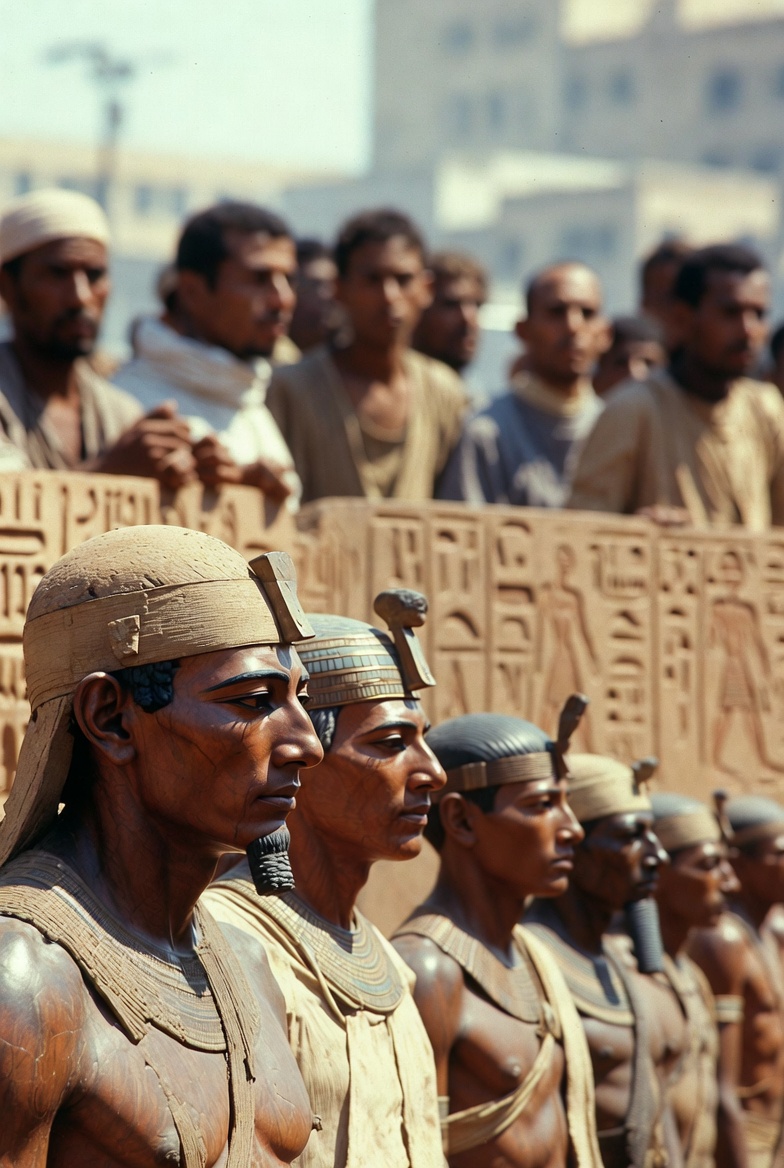
So is there a connection between then and now?
Yes. And no.
Yes – in the sense that the glorious past has become a burden.
When you live in a country that once stood at the center of the world, it’s hard to accept a present dependent on foreign aid and tourism.
And no – in the sense that modern Egyptians did not inherit the knowledge, only the myth.
And myth, without intellectual tools, turns into a weapon of perception.
Final note: not hatred, but cultural tragedy
Egyptians are not a metaphysical enemy.
They are a society stuck between a mythological past and a painful present, without an intellectual bridge connecting the two.
And when there is no bridge – people build a story.
And when they build a story – someone always ends up as the villain.
The problem isn’t the man on the street.
The problem is the street itself – one without education, hope, or accountability.
And the greatest irony of all?
If Egyptians were actually allowed to study their history honestly –
not the myth, but the complexity –
they might discover something truly dangerous:
That their problems didn’t begin with Zionism.
And that their solutions don’t pass through hatred.
But that’s a different story.
And a much less comfortable one.
הירשמו כדי לקבל את הפוסטים האחרונים אל המייל שלכם