
Will Israel Be the One to “Liberate” the Persian People from the Islamic Republic?

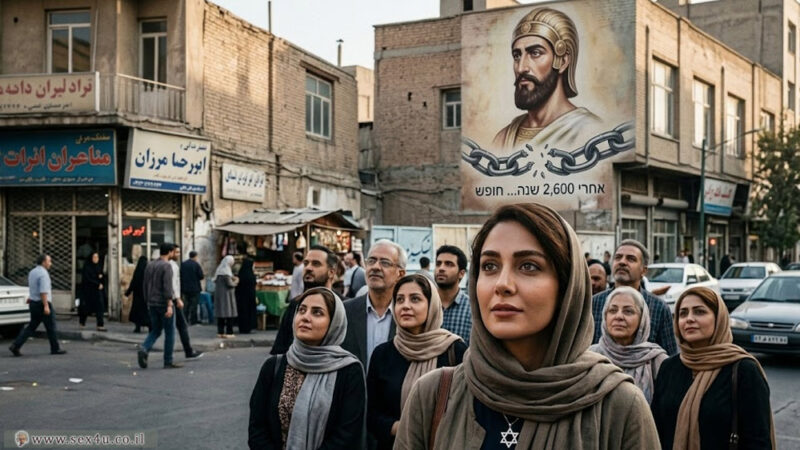
2,600 Years After the Cyrus Declaration – Will Israel Be the One to “Liberate” the Persian People from the Islamic Republic?
History has a strange sense of humor.
Sometimes it even has a long memory and a darker punchline.


In 539 BCE, Cyrus the Great – King of Persia – allowed the Jewish exiles to return to Jerusalem. It was a rare imperial move: pragmatic tolerance instead of endless suppression. Cyrus became a biblical hero, a symbol of enlightened rule, and arguably the best PR campaign ancient Persia ever ran.
Fast forward 2,600 years.
Now the geopolitical script appears inverted. The modern State of Israel finds itself confronting the Islamic Republic of Iran. And somewhere between drone strikes, sanctions, and strategic doctrine, a provocative question emerges:
Could history pull off the ultimate ironic twist?
Could Israel play a role – direct or indirect – in freeing the Persian people from the rule of the Ayatollahs?
Before we get carried away with Netflix-level symbolism, let’s unpack this carefully – and cynically.
Cyrus vs. The Clerics: A Study in Governing Philosophy
Cyrus ruled by strategic inclusion.
The Islamic Republic rules by ideological consolidation.
Cyrus understood that empires survive through legitimacy and administrative intelligence.
The Ayatollah regime has survived through control, ideology, and security structures.
One expanded influence by allowing diversity.
The other maintains power through religious-political centralization.
The irony is not subtle.
Ancient Persia once symbolized enlightened imperial pragmatism. Modern Iran often projects revolutionary rigidity. That historical contrast fuels much of today’s romantic speculation.
But romantic speculation is not strategy.
Does Israel Even Intend to “Liberate” Anyone?
Let’s strip away mythology.
Israel’s national security doctrine is not messianic.
It is defensive, preemptive, and interest-driven.
If Israeli military action impacts regime stability in Tehran, it is a byproduct of security calculations – not a liberation campaign.
States act in self-interest.
Liberation narratives usually appear later, written by historians and columnists.
Yet history has shown that external pressure can accelerate internal transformation. Not create it – accelerate it.
That distinction matters.
The Persian People Are Not the Regime
One of the most strategically important realities often ignored in political rhetoric:
The Iranian population is not synonymous with the Islamic Republic.
Iran is:
- A 2,500-year-old civilization
- A highly educated society
- A digitally connected youth population
- A culturally diverse state
Within Iran, admiration for pre-revolutionary history, including Cyrus, has resurged in recent years. National identity does not always align neatly with ideological governance.
So the real question becomes:
If regime pressure intensifies externally, does it weaken the system – or strengthen it through nationalist backlash?
History provides examples of both outcomes.
The “Reverse Cyrus” Scenario
Let’s imagine a speculative but plausible chain reaction:
- Sustained external pressure targets regime infrastructure.
- Economic strain deepens internal fractures.
- Elite factions diverge on strategic direction.
- Public dissent expands.
- Security cohesion erodes.
At that point, does Israel “liberate” Iran?
No.
But could Israeli (and allied) actions contribute to conditions under which internal transformation becomes possible?
Yes.
Regimes rarely fall solely from outside force. They fall when internal legitimacy collapses under compounded pressure.
The Dangerous Side of Historical Symmetry
It’s tempting to frame this as poetic justice.
Cyrus freed the Jews.
Now the Jews free the Persians.
It sounds cinematic. It reads well in opinion columns.
But geopolitics is not a morality play.
Regime collapse does not guarantee democratic rebirth.
Power vacuums do not automatically produce constitutional reform.
The Middle East has provided ample reminders that “liberation” can morph into fragmentation.
So while the symmetry is intellectually seductive, the reality would be complex, unstable, and unpredictable.
Why the Idea Resonates Anyway
The narrative persists because it taps into something psychologically powerful:
Historical reciprocity.
There is symbolic appeal in imagining a civilizational circle closing after 26 centuries. It suggests destiny, balance, poetic justice.
But history does not operate on cosmic debt repayment.
It operates on structural stress.
If the Islamic Republic weakens in the coming years, it will not be because of biblical symmetry. It will be because internal and external pressures intersect at the right moment.
Could Israel Be a Trigger?
Potentially – but only as one variable.
External military and economic pressure can:
- Undermine regime economic networks
- Increase elite uncertainty
- Shift risk calculations among power brokers
- Signal declining international tolerance
But sustainable political transformation must originate domestically.
No state can export legitimacy.
If the Persian people ever reshape their governance structure, it will be their decision – even if external dynamics accelerate the timeline.
The Real Irony
Here’s the part history might actually appreciate:
The Islamic Revolution of 1979 was built partly on anti-Western and anti-Israeli rhetoric.
If long-term confrontation with Israel contributes to systemic strain inside Iran, then the regime’s defining ideological pillar would indirectly become a source of its vulnerability.
That would be irony – not mythology.
So… Will Israel “Free” Iran?
Short answer: No – not in the heroic, cinematic sense.
Long answer: Israel could play a role in shaping conditions that influence the Islamic Republic’s durability. But regime change, if it ever occurs, will ultimately be decided within Iran’s own political and social ecosystem.
If one day Iran transitions toward a different model of governance, historians may draw a symbolic line back to 2026, just as they draw one back to 539 BCE.
But that will be narrative construction – not divine symmetry.
The Bottom Line (Because Even Cynicism Needs Closure)
Is it possible that 2,600 years after Cyrus allowed Jewish exiles to return home, Israel could become a catalyst in a transformative chapter of Iranian history?
Possible? Yes.
Predestined? No.
Strategically engineered as a historical repayment? Definitely not.
If history does complete a circle, it will not be because ancient scrolls demanded it.
It will be because pressure, power, and politics aligned at a precise moment.
And if that happens, the ultimate liberation – should it occur – will belong to the Persian people themselves.
History may enjoy irony.
But freedom is never outsourced.
הירשמו כדי לקבל את הפוסטים האחרונים אל המייל שלכם