
Clickbait: The Art of Exaggeration

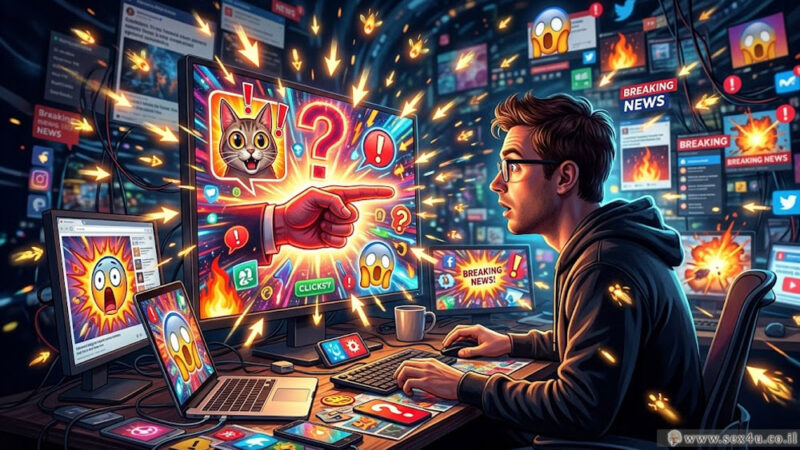
Once upon a time, journalism was a profession.


Today, it is mostly a competition between headlines like:
“You Won’t Believe What Happened When He Opened the Fridge”
and
“The Dramatic Move That Will Change Your Life by Tomorrow Morning!!!”
And of course – always three exclamation marks, because with only one, people might mistakenly assume the information is real.
Welcome to the age of clickbait – where every minor event is a “drama,” every tweet is a “storm,” and every politician raising an eyebrow instantly becomes a “political earthquake.”
Reality itself is no longer enough.
It needs special effects.
The News Is Dead, Long Live the Headline
The problem is simple:
Nobody makes money from you knowing the truth.
They make money from you clicking.
The media business model shifted from information to temptation.
Once, a newspaper wanted you to trust it.
Today, a website wants you to fall for it.
The difference is small, but like the difference between a doctor and a used-car salesman – you feel it immediately.
A headline like:
“The Finance Minister Presented a New Plan”
will not generate traffic.
But:
“The Secret Move by the Finance Minister That Will Shake Every Household in Israel”
Now that sounds like something worth opening in the middle of a work meeting.
Then you read 700 words and discover it is about a 12-cent increase in cottage cheese.
“Storm on Social Media” – Meaning Three People on Twitter
There is no more modern Israeli phrase than “a storm on social media.”
Once, a storm meant war.
Today, it means two tweets, one angry Instagram story from an influencer, and a news anchor dramatically announcing:
“The reactions were immediate.”
Of course they were immediate.
They were written before the event even happened.
The media discovered it can take one random person with 43 followers, turn him into “the internet,” and report that “the public is furious.”
And so, Israel in 2026 is often emotionally managed by people whose Twitter handle looks like:
“AngryZionist1978”
Every Politician Is a “Senior Official”
Israel has more “senior officials” than actual citizens.
“Senior security official”
“Senior coalition source”
“Former senior official familiar with another senior official”
They all leak.
They all warn.

They all are “deeply concerned.”
If all these anonymous people actually existed at full capacity, the country would be run by a union of mysterious men in parking lots.
But clickbait does not need certainty.
It needs mystery.
Because:
“Some guy said something vague”
is weak.
But:
“Senior Official Warns: Israel Facing Historic Turning Point”
Now that sounds like the end of civilization, or at least a special panel on prime-time television.
Health, Consumer News, and Cheap Fear
This is where clickbait becomes a true art form.
“You Eat This Every Day – And It Could Kill You”
After opening the article, you discover they are talking about bread.
Or water.
Or oxygen.
Depends on the advertiser.
Fear sells beautifully.
If you can convince someone that their avocado is a strategic threat, they will keep reading.
The media understood long ago that anxiety is far more profitable than information.
That is why every early-stage study becomes a “dramatic discovery,” and every weak statistic turns into “scientific proof.”
Politics as Performance
Politicians learned the method too.
They no longer speak to the public.
They speak to the headline.
It does not matter what was said.
It matters how it looks in the evening news intro.
One sharp sentence is worth more than an entire policy plan.
Why explain a complex reform when you can just say:
“We will not let them steal the country”
Short.
Angry.
Effective.
Clickbait evolved from a marketing trick into a governing strategy.
The Public Is Guilty Too. Yes, You.
This is the uncomfortable part:
The media did not invent clickbait alone.
We ordered it.
We click.
We share.
We get angry.
We type “unbelievable” and then immediately open the exact thing we claim is unbelievable.
The system learned us well.
It knows we prefer outrage over precision, drama over depth, and scandal over a boring table with actual numbers.
Truth is too slow.
Anger is faster.
The Bottom Line
Clickbait is not a bug in modern media.
It is the business model.
It is the method of turning information into entertainment, citizens into consumers of anxiety, and politics into reality television with fewer talented people and more spokespersons.
Everyone participates:
The journalist,
The politician,
The commentator,
And the reader who swears he was “just checking.”
The solution?
Probably not in a headline saying:
“This One Simple Trick Will Save Democracy!”
But it starts with one small moment of suspicion:
When you see a headline that sounds like the end of the world-
maybe, just maybe,
it is just another ordinary Tuesday in Israel.
הירשמו כדי לקבל את הפוסטים האחרונים אל המייל שלכם
Discover more from Intelligent is sexy
הירשמו כדי לקבל את הפוסטים האחרונים אל המייל שלכם