
Politicians and Interviews: The Art of Saying Absolutely Nothing in 20 Minutes

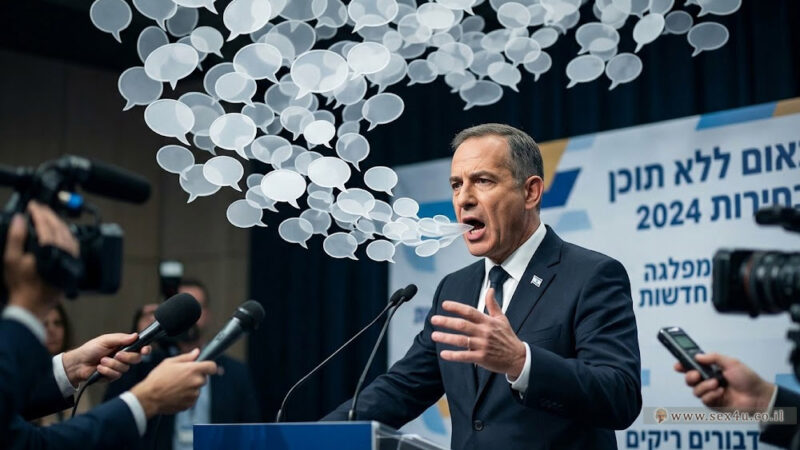
There are rare talents in this world.


Some people play music without reading notes.
Some solve equations in their heads.
And then there are Israeli politicians, who can speak for twenty straight minutes without saying a single thing that can actually be verified.
This is not a bug.
It is an art form.
A political interview in Israel is not a conversation.
It is a professional escape performance.
The interviewer asks:
“Yes or no?”
The politician replies:
“First of all, we need to understand the regional complexity.”
Translation:
No, but I would prefer that you get tired before I have to admit it.
The Question Is Only a Suggestion
A normal citizen thinks an interview works like this:
Question → Answer
A politician knows the real structure is:
Question → Childhood story from the periphery → Attack on the opposition → Blame the media → End with “We are working for the public”
The actual answer?
That is premium content.
The goal is not to answer.
The goal is to survive the question without creating a dangerous headline.
“Let Me Tell You What the Real Problem Is”
This is the official sentence of someone with absolutely no intention of answering.
The interviewer asks about the cost of living.
The minister responds:
“Let me tell you what the real problem is – for years, the citizen has been neglected.”
Wonderful.
But at the moment, you are the minister.
That is a bit like a firefighter arriving at a burning building and saying:
“Let me tell you what the problem is – there is fire.”
Thank you, Sherlock.
“I Will Not Comment on an Ongoing Investigation”
The magic phrase of Israeli politics.
If he says it once – there is a problem.
If he says it twice – there is a lawyer.
If he says it while smiling – there is also a media consultant.
In Israel, “I will not comment” is often the most honest thing said in the entire interview.
The Media Plays Along
The interviewers are not really surprised either.
They know they will not get an answer.
The politician knows they know.
The viewers know everybody knows.
And still it continues, like a family wedding nobody enjoys but everyone attends.
Sometimes the interviewer makes a serious face, asks again, maybe even raises an eyebrow.
That is it.
The battle for truth has reached its dramatic peak.
Tomorrow, the same politician will return for another interview, because even fake drama needs a regular broadcast schedule.
The Standard Phrases of Empty Air
Every politician has a survival kit for live television:
“We are examining all options”
Meaning: we have no idea.
“We will not accept moral lectures”
Meaning: someone just gave one.
“We will respond at the right time and place”
Meaning: currently, there is no response.
“The public is smart”
Meaning: I hope they are not.
“Whoever needs to provide answers will provide them”
Meaning: definitely not me.
It is a full language.
Spoken Hebrew with simultaneous translation into professional evasion.
Post-Failure Interviews: A Genre of Their Own
This is where the art reaches perfection.
After a disaster, a failure, a collapse, or a historic embarrassment, the politician arrives at the studio looking like a man who just discovered reality was filmed without a filter.
He will say:
“I take full responsibility”
Which is impressive, because it is usually said five minutes before he refuses to resign.
Responsibility in Israel is a spiritual concept.
You can feel it.
People talk about it.
But you almost never see it in physical form.
The Public Has Learned the Game
People used to listen seriously.
Now they play bingo.
If someone says “complex” – take a shot.
If someone blames “the media” – take another.
If he blames the previous government despite being in office for two years – two shots.
By the end of the interview, half the country is drunk.
Which may be our most stable national achievement.
Why Does It Work?
Because vagueness is insurance.
A clear answer can be quoted.
A promise can be checked.
But a sentence like:
“We will act decisively with broad national responsibility”
sounds impressive while meaning absolutely nothing.
It is like political perfume:
everyone smells authority, nobody finds active ingredients.
The Bottom Line
Politicians do not give interviews to explain.
They give interviews to survive.
Not to provide information – but to prevent damage.
The perfect interview, from their perspective, ends with the public saying:
“I understood nothing, but he sounded very confident.”
And in Israel, that is practically considered a policy platform.
So next time you watch a political interview, do not ask:
“Did he answer?”
Ask:
“How many minutes did he successfully escape without blinking?”
Because in a country where everyone demands transparency,
the most stable profession is still the art of fog.
הירשמו כדי לקבל את הפוסטים האחרונים אל המייל שלכם
Discover more from Intelligent is sexy
הירשמו כדי לקבל את הפוסטים האחרונים אל המייל שלכם