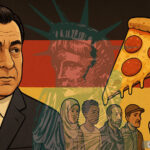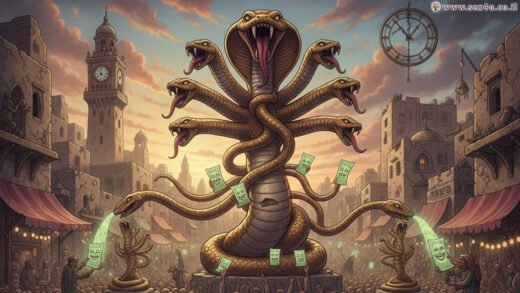
Europe on the Couch

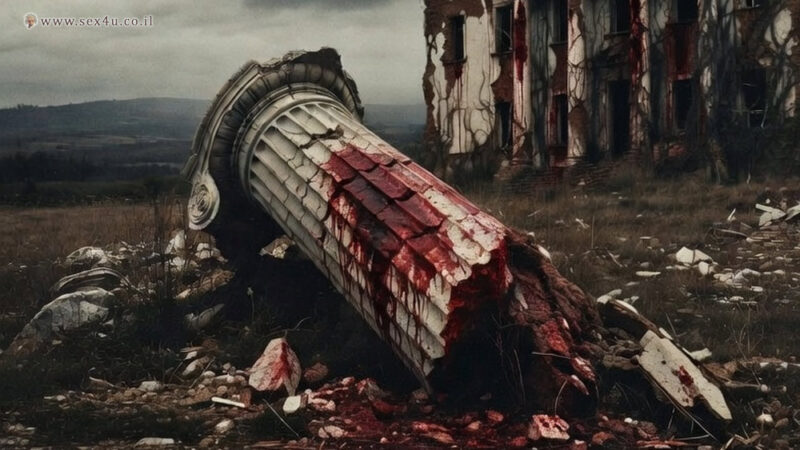
Is Western Civilization Terminally Ill – or Just Badly Diagnosed?
Every civilization eventually reaches a moment of self-examination. Not the polite kind of reflection that happens in university seminars, but the kind that sounds more like an existential crisis.


Europe, these days, seems to be having exactly that conversation.
On one side stands the intellectual and cultural legacy of the Age of Enlightenment – the philosophical revolution that helped shape modern Western ideas about liberty, secular governance, free speech and individual rights. That legacy was reinforced by events like the French Revolution and later embedded in the institutions of modern democratic states.
On the other side stands a dramatically changing demographic and cultural landscape: large-scale immigration, rising religious identity, and the growing presence of Islam in many European cities.
Between those two realities, a loud and often uncomfortable question has emerged:
Is European civilization entering a historical decline – or merely undergoing a difficult transformation?
To answer that question, it helps to understand how Europe arrived at this moment.
How Europe Built Its Modern Identity
For most of its history, Europe was not the calm, prosperous place it is often imagined to be today. It was fragmented, violent, and frequently at war with itself.
Empires rose and fell. Religious conflicts devastated entire regions. Borders shifted constantly.
Yet from that chaos emerged a new political idea: societies governed not by divine authority or dynastic power, but by law and individual rights.
Philosophers such as John Locke, Voltaire and Montesquieu articulated concepts that would later become the foundation of modern liberal democracy.
Their arguments were radical at the time: governments should be limited, citizens should have rights, and religious institutions should not dominate the state.
It was far from a smooth process. Europe still managed to produce the catastrophic World War I and World War II.
But after 1945, something remarkable happened.
European states decided – more or less collectively – that endless internal conflict was no longer acceptable.
The result was one of the most ambitious political projects in modern history: the creation of the European Union.
The Demographic Problem
Then came a quieter, less dramatic challenge – demographics.
Across much of Europe, birth rates began to decline sharply.
Countries like Germany, France and Italy now face aging populations, shrinking workforces and growing social welfare obligations.
In simple economic terms, fewer young workers must support more retirees.
The policy response adopted by many European governments was immigration.
Millions of migrants entered Europe over the past few decades, many from North Africa and the Middle East.
The theory behind this policy was straightforward: immigration would replenish the workforce, sustain economic growth and support pension systems.
Reality, however, proved more complicated.
The Multicultural Experiment
Beginning in the 1990s, many European countries embraced multiculturalism as a governing philosophy.
The idea sounded appealing. Different cultures could coexist, enrich one another, and create more diverse societies.
In practice, integration has produced mixed results.
Major European cities such as Paris, Brussels and Stockholm developed neighborhoods where immigrant communities became culturally dominant.
In some areas, integration succeeded. In others, parallel societies emerged.
These developments fueled a difficult political debate:
How open can a society remain before openness begins to undermine social cohesion?
Europe’s Internal Identity Crisis
Immigration alone does not explain Europe’s current tensions.
A deeper issue lies within European cultural self-confidence.
For decades, many intellectual and political elites in Europe emphasized critical reassessment of their own history – particularly colonialism, nationalism and the catastrophes of the twentieth century.
Self-criticism is healthy in democratic societies. But in some cases it evolved into something closer to historical guilt.
When a civilization begins to doubt the legitimacy of its own values, defending those values becomes more complicated.
This psychological shift created a vacuum that competing cultural narratives could easily fill.
Islam in the European Context
The presence of Islam in Europe is not new. Muslim communities have existed in parts of the continent for centuries, particularly in regions historically connected to the Ottoman Empire.
However, immigration in recent decades significantly expanded Muslim populations in Western Europe.
Most of these communities are composed of ordinary families seeking stability, economic opportunity and security.
Yet alongside these communities, a smaller but highly visible phenomenon emerged: ideological radicalization.
Extremist organizations such as ISIS and Al-Qaeda have occasionally exploited Europe’s open societies to recruit supporters or stage attacks.
Such incidents remain statistically rare relative to Europe’s overall population, but their psychological and political impact has been substantial.
Political Reactions
When societies undergo rapid cultural change, politics inevitably reacts.
Over the past decade, several political movements emphasizing national identity, immigration restrictions and cultural preservation have gained influence across Europe.
Figures like Marine Le Pen in France and Geert Wilders in the Netherlands have become prominent voices in these debates.
Supporters argue that these movements defend national identity and social stability.
Critics warn that they risk undermining liberal democratic values.
The result is a political landscape increasingly defined by polarization.
Is Europe Actually Declining?
Despite the dramatic tone often used in political debates, declaring Europe’s collapse would be premature.
Europe remains one of the wealthiest and most technologically advanced regions on Earth.
Its universities, research institutions and industries continue to produce significant innovation.
Democratic institutions remain robust, and civil society remains active and influential.
Yet it is equally true that Europe faces genuine challenges.
Demographic shifts, cultural tensions and political fragmentation are real phenomena, not imaginary ones.
The question is not whether Europe faces problems.
The question is how it will respond to them.
The Pessimistic Scenario
In the pessimistic scenario, Europe continues to struggle with unresolved tensions.
Immigration remains poorly managed, integration policies fail to produce social cohesion, and political polarization intensifies.
Under such circumstances, trust in democratic institutions could gradually erode.
History provides many examples of societies destabilized by prolonged uncertainty.
The Optimistic Scenario
The optimistic scenario is also plausible.
Europe has faced major crises before – world wars, economic collapse, ideological conflict – and repeatedly reinvented itself.
A recalibration of immigration policies, stronger integration frameworks and renewed cultural confidence could stabilize the current situation.
Rather than abandoning liberal values, Europe may simply redefine how those values function in a more complex society.
The Cynical Conclusion
So is Western European civilization dying?
Probably not.
But it sometimes behaves like a patient who walks into a doctor’s office with a long list of symptoms: fatigue, identity confusion, and a suspicious amount of ideological indigestion.
The real question is not whether Europe will survive.
It almost certainly will.
The more interesting question is what kind of Europe will emerge from this period of uncertainty.
Will it remain recognizably Western in its cultural foundations?
Or will it evolve into something entirely new?
History, as always, has a habit of surprising those who confidently declare the end of the story.
הירשמו כדי לקבל את הפוסטים האחרונים אל המייל שלכם