Is Europe Heading Toward Sharia – or Toward Losing Its Spine?

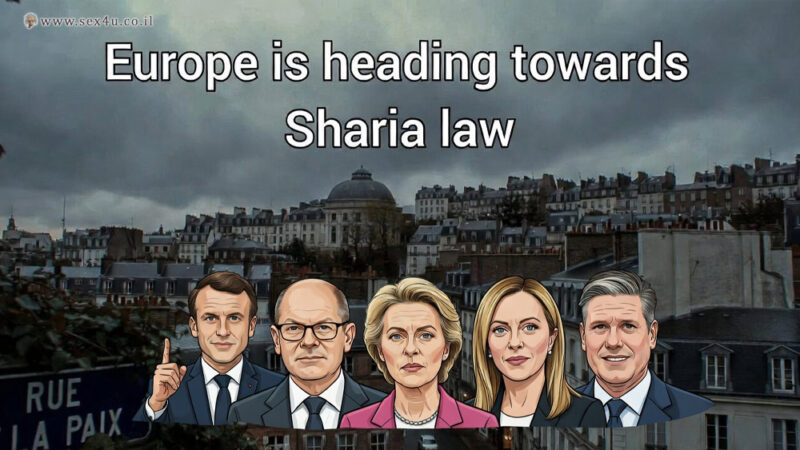
No, Sharia Won’t Be Voted In – It Slips In Through the Back Door
No parliament in Paris, Berlin, or Amsterdam is about to pass a “Sharia Constitution.”
That’s not how Europe works.


But anyone comforting themselves with that sentence is missing the bigger picture:
major civilizational shifts don’t arrive by announcement – they creep in.
Europe’s real problem isn’t a formal adoption of Sharia.
It’s something far less dramatic – and far more dangerous:
loss of confidence, political hesitation, and a chronic fear of confrontation.
While bureaucrats draft statements and committees debate wording, reality keeps moving.
Europe in 2026: Wealthy, Polite – and Deeply Uncertain
Modern Western Europe is a paradox:
- Economically powerful
- Politically hesitant
- Culturally conflicted
It excels at sanctions, statements, and values-based rhetoric.
It struggles when asked a simple question:
What are you actually willing to defend?
That question is no longer theoretical.
The Link Nobody Wants to Talk About: Internal Weakness Meets External Pressure
At the same time Europe is dealing with immigration, identity, and religion,
it is also facing a harder geopolitical reality.
The ongoing confrontation with Iran – even when indirect – exposed something uncomfortable:
👉 NATO looks strong on paper – less decisive in action
👉 European states remain heavily dependent on the U.S.
👉 Decision-making is slow, fragmented, often paralyzed
And here’s the key point:
A system that struggles to confront external threats
will struggle even more with internal ones.
So No, Sharia Isn’t “Coming” – But Something Else Is
The real question is not “Will the law change overnight?”
It’s: Are norms, enforcement, and reality already changing?
What we actually see on the ground:
- Areas where law enforcement presence is weaker
- Communities operating with parallel social norms
- Informal pressure outweighing formal law
This isn’t “official Sharia.”
It’s something quieter:
A parallel reality.
Why Is This Happening? Because Europe Avoids Confrontation
Modern Europe is built on one core principle:
compromise, as far as possible.
That works well in:
- economics
- diplomacy
It works far less well when dealing with:
- competing value systems
- strong identities
- groups that don’t share the same assumptions
At that point, endless compromise stops being a solution –
and becomes a vulnerability.
Advantages (Yes, There Are Some – On Paper)
✔ Protection of religious freedom
✔ Avoidance of immediate conflict
✔ Short-term social stability
✔ Preservation of liberal image
Disadvantages – Where the Cost Shows Up
✖ Erosion of national identity
✖ Reduced control in certain areas
✖ Laws that exist but aren’t consistently enforced
✖ Growing gap between policy and reality
And most importantly:
✖ A creeping sense of insecurity among the public
Common Mistakes in Analyzing the Situation
❌ Mistake 1: “If it’s not law, it’s not happening”
Law is only one layer.
Culture and enforcement matter just as much.
❌ Mistake 2: All-or-nothing thinking
Either full Sharia or nothing.
Reality moves gradually, not in dramatic switches.
❌ Mistake 3: Ignoring demographics
Population changes → political pressure changes.
❌ Mistake 4: Blind trust in institutions
Institutions still exist – the question is how effectively they function.
Who Benefits from the “Everything Is Fine” Narrative
- Politicians seeking short-term calm
- Bureaucracies that prioritize stability
- Media that prefers avoiding friction
Who Should Be More Skeptical
- Anyone thinking long-term
- Anyone tracking trends rather than headlines
- Anyone who understands that history rarely moves in sudden leaps
So What’s the Real Probability?
Let’s be precise:
👉 There will be no parliamentary vote to replace European law with Sharia
👉 No Western European constitution is about to be rewritten along religious lines
But:
👉 There will be localized shifts in norms
👉 There will be concessions in the name of “social peace”
👉 There will be increasing friction beneath the surface
The Bottom Line: Not Collapse – But Not Stability Either
Europe is not about to become a Sharia-based system.
But it is facing a deeper issue:
A weakening ability to define its own boundaries – and enforce them.
And that, far more than any headline, is the real story.
Practical Conclusion – Clear and Direct
If you’re waiting for a formal declaration, you’ll stay calm.
If you’re watching real-world trends, you’ll see something else.
👉 No revolution – but gradual erosion
👉 No official shift – but quiet concessions
👉 No immediate collapse – but long-term pressure
Final conclusion:
Europe’s problem isn’t Sharia.
It’s uncertainty about its own identity.
And when a society stops defining itself clearly,
something else inevitably fills the vacuum.
הירשמו כדי לקבל את הפוסטים האחרונים אל המייל שלכם
Discover more from Intelligent is sexy
הירשמו כדי לקבל את הפוסטים האחרונים אל המייל שלכם