
God in the Technological Age

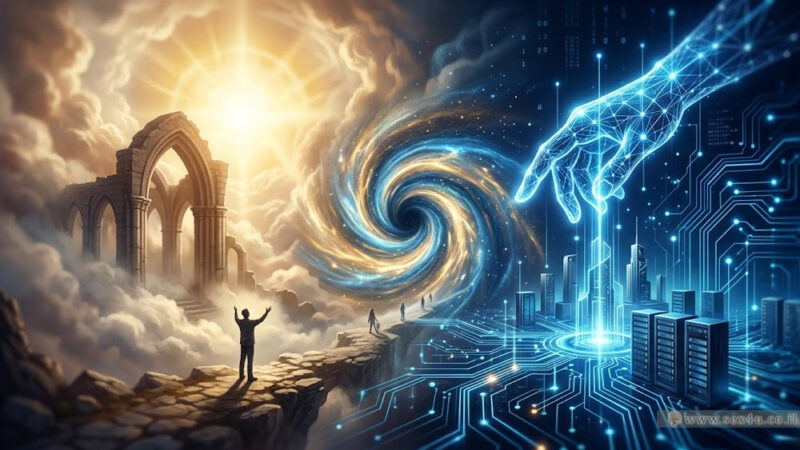
We Used to Wait for the Messiah. Now We Wait for a Software Update
Once upon a time, when a person had an existential crisis, he climbed a mountain, spoke to God, came down with stone tablets, and started a religion.


Today?
He opens ChatGPT, types “What is the meaning of life?”, gets a polite answer, and then spends three hours arguing with a Russian bot on Twitter.
Progress.
Or maybe not.
We live in an age where your phone knows more about you than your parents do, the algorithm understands your desires before you admit them to yourself, and “the cloud” – that mystical invisible entity – stores more secrets than the Vatican.
In short, if God came down to Earth today, He would probably first need two-factor authentication.
The real question is no longer whether God exists.
The question is whether He has already migrated to digital.
“In the Beginning God Created the Heavens and the Earth” – Then Customer Support Arrived
If you study the major religions, you notice something fascinating: they all operate like a complicated relationship with customer service.
You pray – no immediate response.
You ask for a sign – the electricity goes out.
You ask for financial stability – your bank sends a message about exceeding your credit limit.
In many ways, God has always functioned like an Israeli internet provider:
essential, powerful, unavoidable – and strangely unavailable exactly when you need Him most.
Then technology arrived and promised to solve everything.
No need for prayer – there’s an app.
No need for community – there’s social media.
No need for a rabbi, priest, or philosopher – there’s a 23-year-old influencer with a podcast and very strong opinions about geopolitics.
The problem is that technology did not eliminate the human need for faith.
It simply replaced the object of worship.

Once They Worshipped the Golden Calf. Today They Worship the Golden iPhone
The biblical story is familiar:
Moses goes up the mountain, the people lose patience, and they decide to worship a shiny golden statue.
We laugh at them.
Primitive people.
Today, people sleep on sidewalks to buy the newest iPhone for $1,500, even though the old one still works perfectly fine – except now the camera captures anxiety in higher resolution.
But yes, of course, we are much more enlightened.
Technology did not eliminate idolatry.
It simply gave it fast charging.
People no longer ask, “What is right?”
They ask, “How many likes will this get?”
Morality became an algorithm.
Truth became a feed.
And the new prophet is whoever has the most followers.
If Moses came down from Mount Sinai today carrying the Ten Commandments, his first question would be whether they had viral Reels potential.
God, Artificial Intelligence, and Who Actually Runs the World
This is where things become truly interesting.
Humanity created artificial intelligence from a noble dream:
to help, improve, optimize, and solve.
In practice?
We use it to write emails we are too lazy to write ourselves, generate images of politicians as avocados, and ask whether our ex still thinks about us.
Peak civilization.
But beneath the joke lies a serious question:
if we create a system that knows everything, sees everything, analyzes everything, and makes decisions better than we do – how is that not a functional form of divinity?
People once said:
“God knows everything.”
Now they say:
“The algorithm knows everything.”
At least with God, there was the illusion of free will.
Now Netflix decides what you watch and when you should feel guilty about it.
The New Religion: ESG, Wokeism, and the Sacred Church of Correctness
Here comes the Western twist.
Because the West did not actually stop believing.
It simply replaced the holy book.
Instead of the Ten Commandments – corporate behavioral guidelines.
Instead of sin – an old tweet from 2014.
Instead of confession – a LinkedIn apology post.
And instead of Hell – cancellation.
It is religion in every practical sense:
heresy, purity rituals, public humiliation ceremonies, and digital inquisitions with blue verification checkmarks.
Anyone who thinks the modern world became less religious has clearly not visited a Western university recently.
There you will find people who believe in 47 genders but become morally offended if you suggest history began before TikTok.
In Israel, Even God Needs Committee Approval
In Israel, the story is even better.
Here, God not only exists – He also needs Supreme Court approval, an IDF spokesperson statement, and a prime-time panel discussion on Channel 12.
Religion, nationalism, technology, and politics all live together in one small apartment without air conditioning.
The Start-Up Nation prays in the morning for a successful IPO, at noon for Iron Dome, and in the evening that someone will finally fix Wolt deliveries.
We are a nation that builds some of the most advanced defense systems on Earth, while still saying “בלי נדר” (“without making a vow”) in WhatsApp messages.
And honestly, that is beautiful.
Because it means that even in an age of satellites, cyber warfare, and AI, Israelis still understand that some things cannot be solved with an app.
Like parking in Tel Aviv.
Or the United Nations.
The Final Modern Prayer: “Please Let My Battery Survive”
Let’s be honest:
most modern prayers are no longer about salvation.
They sound more like this:
“God, please don’t let my battery die before I reach the building code.”
“Lord, let it be that I did not send that message to the wrong group chat.”
“Merciful Creator, protect me from Reply All.”
This is not heresy.
It is simply evolution.
Human beings have always prayed about whatever frightened them most.
Once it was drought, war, and plague.
Now it is 3% battery, leaked screenshots, and Zoom interviews with broken cameras.
The fear changed.
The mechanism remained.
So Where Is God in All This?
Maybe exactly there.
Not in thunder from the heavens.
Not inside an app.
Not on Twitter.
But in the rare moment when a person stops inside all this noise and asks a real question.
Not “How do I go viral?”
But “How do I become a decent human being?”
In an age where everything is fast, cynical, automated, and sponsored by targeted advertising, the very act of searching for meaning is almost a religious act.
Maybe that is the entire point.
God did not disappear.
He just became harder to hear when notifications are always on.
Final Conclusion: On the Eighth Day, God Created Wi-Fi – and Immediately Regretted It
Technology did not kill God.
It simply created competition.
We still search for faith, belonging, meaning, and order.
We just enter an app instead of a temple.
We follow influencers instead of priests.
And instead of fasting on Yom Kippur, we do a two-hour “digital detox” and proudly post about it afterward.
The problem is not that we stopped believing.
The problem is that we started believing in much stupider things.
But perhaps that has always been the human condition.
After all, humanity survived Pharaohs, empires, ideologies, and Twitter.
There is a fair chance we will survive this too.
Assuming the battery does not die first.

הירשמו כדי לקבל את הפוסטים האחרונים אל המייל שלכם
Discover more from Intelligent is sexy
הירשמו כדי לקבל את הפוסטים האחרונים אל המייל שלכם