
Experts

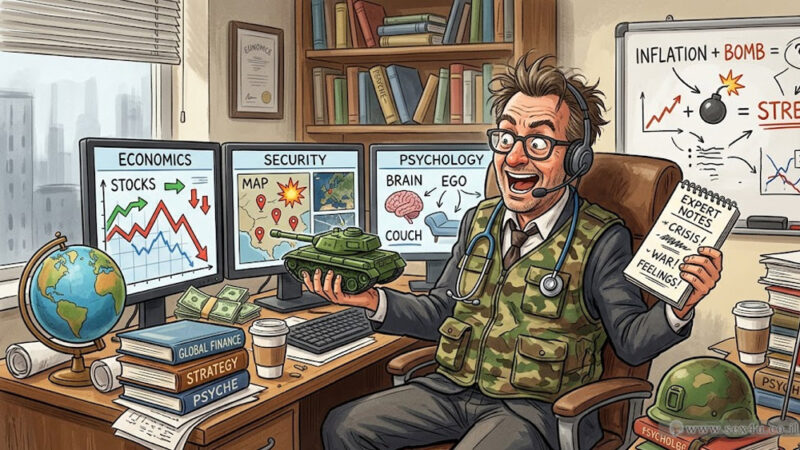
How to Become an Economist, Security Analyst, and Psychologist in One Day
A Practical Israeli Guide for Beginners (and Confident Amateurs)
Some professions take years to master.


Medicine.
Engineering.
Law.
And then there is one special profession, proudly Israeli, beautifully modern:
✹ The Universal Expert
No degree required.
No experience necessary.
And ideally, no shame.
All you need is:
Wi-Fi and strong opinions.
Welcome to 2026: The Nation of Experts
Today, the average citizen is:
- An economist when prices go up
- A security analyst when rockets fly
- A psychologist during family dinner
And if possible – all three at once, in one Facebook post.
Because why specialize…
when you can simply comment?
Step One: Economics – “It’s All Government Failure”
The first rule of modern economic analysis is simple:
✹ If something is expensive – blame the government
✹ If something works – it happened despite the government
Elegant.
Efficient.
Requires absolutely no reading.
How to Become an Economist in 3 Easy Steps:
- Say “cost of living crisis”
- Add “insane taxation”
- Finish with “terrible management”
Congratulations.
You are now ready for prime-time television.
Bonus Level:
If someone asks for actual numbers, simply say:
“It’s more complicated than that.”
Then continue talking.
Never stop talking.
Step Two: Security Expert – “I Would Have Done It Differently”

Now we enter sacred Israeli territory.
Every citizen who once served three months near a military warehouse
is now a strategic mastermind.
How to Become a Security Expert in 5 Minutes:
- Start with: “I don’t understand how…”
- Continue with: “They should have already…”
- End with: “There is no deterrence”
Done.
You are now officially smarter than the entire General Staff.
Advanced Vocabulary:
No matter what happens, call it:
✹ “A conceptual failure”
Nobody really knows what that means,
but it sounds expensive and important.
Use it often.
Step Three: Psychology – “This Is Clearly Trauma”
Now we reach the elite level.
You no longer need facts.
You just need to diagnose other people emotionally.
Golden Rules of Modern Pop Psychology:
- Every problem is “trauma”
- Every bad decision is “suppression”
- Every argument is “a defense mechanism”
And if someone disagrees with you?
✹ They’re simply “not processing their emotions.”
Case closed.
Invoice pending.
The True Art: Combining All Three
This is where you become a Master Expert.
A standard social media post now sounds like this:
“The economic crisis is the result of deep strategic failures causing national trauma, which explains the lack of growth.”
What does that actually mean?
Nobody knows.
But it sounds serious.
And seriousness is half the profession.
Why Does This Work?
Because in the age of information,
we don’t suffer from lack of data.
We suffer from lack of:
✹ actual understanding
✹ depth
✹ proportion
And when depth disappears,
the loudest voice wins.
Not the smartest.
Not the most informed.
Just the loudest.
A beautiful system, really.
The Media: Accelerating the Disease
This is where mainstream media enters the chat.
Because instead of saying:
“We don’t know yet”
…it prefers:
- “Senior analyst”
- “Expert commentator”
- “High-level source”
to confidently explain everything.
Even if yesterday they confidently explained the exact opposite.
But consistency is for engineers.
Television prefers confidence.
Common Mistakes of Amateur Experts
Mistake #1: Checking Facts
Completely unnecessary.
Facts only create hesitation.
Mistake #2: Admitting You Don’t Know
Dangerous.
This may be interpreted as intelligence.
Avoid.
Mistake #3: Listening to the Other Side
Risky.
You may accidentally learn something.
Mistake #4: Staying in One Field
Why limit yourself?
You have internet access.
Be free.
Be interdisciplinary.
Be wrong everywhere.
A Rare Moment of Honesty
Let’s be serious for ten seconds.
The problem isn’t that people have opinions.
That’s healthy.
That’s democracy.
That’s normal.
The problem is:
✹ when opinion replaces knowledge
✹ when confidence replaces understanding
✹ when noise replaces discussion
That part is less funny.
And What About Real Experts?
They still exist.
- Actual economists
- Experienced military professionals
- Licensed psychologists
But they have one major problem:
✹ They are too complicated.
They use nuance.
They hesitate.
They say things like “it depends.”
The public hates that.
The public wants certainty.
Immediately.
Preferably in under 280 characters.
The Dangerous Gap
When society gets used to:
- shallow explanations
- fake certainty
- instant analysis
something breaks.
A gap opens.
Between reality…
and how we think reality works.
And that gap becomes policy.
Which is where satire quietly stops being satire.
So How Do You Actually Become an Expert?
Here’s the boring answer:
- Study
- Fail
- Gain experience
- Learn complexity
- Accept uncertainty
Unfortunately, this takes years.
And who has time for that
when Twitter exists?
The Bottom Line
In 2026, being an expert is no longer a profession.
It’s a state of mind.
Everyone can do it.
Everyone does do it.
Everyone is absolutely certain they are right.
But beneath all the noise,
one truth remains:
✹ Real knowledge rarely shouts
✹ Real expertise is rarely 100% certain
✹ Reality is always more complicated than the post about it
And in the meantime,
if you’d like to join the national conversation-
don’t bother with facts.
Just pick a subject,
say “I honestly don’t understand how people don’t see this,”
and begin explaining life to strangers.
Welcome to the club.
הירשמו כדי לקבל את הפוסטים האחרונים אל המייל שלכם
Discover more from Intelligent is sexy
הירשמו כדי לקבל את הפוסטים האחרונים אל המייל שלכם