Holocaust Remembrance Day and Me

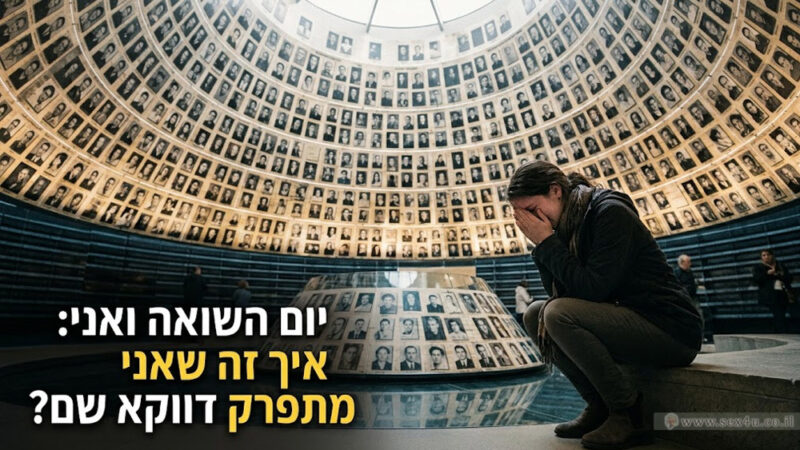
Why Is This the One That Breaks Me?


There is something strange – almost embarrassing – about the fact that Holocaust Remembrance Day hits me harder than Memorial Day for fallen soldiers.
Embarrassing, because on paper, Memorial Day should carry more weight.
It is here. It is ours. These are people in uniforms I recognize, names I hear on the news, sometimes even faces – friends of friends, classmates, people who walked the same streets.
And Holocaust Remembrance Day?
History. Europe. Trains. Black-and-white footage. A story from “back then.”
And yet, somehow, it is precisely this day that tears me apart. Not gently. Not symbolically. Systematically. Layer by layer, like peeling an onion – only without the comforting illusion that something useful comes at the end.
It has been like this since childhood. Every year. Sitting in front of those televised documentaries, fists clenched, jaw tight. A quiet rage that does not dissipate. It stays. From morning into the next day.
So what exactly is going on here?
The illusion of “not being connected”
My family came to this land decades before the Holocaust.
On paper, we missed it.
There are no family stories about camps.
No numbers etched into skin.
No suitcases carrying the smell of Europe.
There is a different narrative:
Middle East, sun, dust, construction, beginnings.
Underground movements, from the days of NILI and Hashomer, and participation in every Israeli war since.
A classic Zionist story – almost too neat, almost like a well-produced campaign.
And so, for years, there has been a quiet assumption beneath the surface:
The Holocaust belongs to others. To European Jewry. To “them” – those who did not come in time, those who failed to see what was coming.
And that is precisely where the illusion collapses.
Because when Holocaust Remembrance Day arrives, it becomes painfully clear:
There is no “them.”
There is only “us.”
The Holocaust does not ask where you came from
The Holocaust is not a story about ethnicity, political affiliation, or belief.
It is a story about a condition.
A condition in which Jews – regardless of whether they came from Poland, Morocco, or Yemen – become a problem to be solved.
And in that moment, all our internal distinctions dissolve.
All the familiar debates – who is more Israeli, more authentic, more rooted – lose their meaning.
Because at the most fundamental level, the Holocaust places everyone in the same line.
And not the kind of line you scroll through on a screen.
A very different kind.
On Holocaust Remembrance Day, there are no heroes
Memorial Day, for all its pain, still offers structure.
There is a narrative. A framework. Even a form of meaning.
Uniforms. Flags. Purpose.
Even when the cost is unbearable, there is a sense of direction – something that holds the story together.
Holocaust Remembrance Day offers none of that.
No control.
No system that protects.
No “sacrifice for a cause.”
What remains is the total collapse of the world as you know it.
And that is a different kind of fear.
Because it did not happen “because we fought.”
It happened because there was nothing left to do.
The deeper fear: that it never truly ended
This is the part that rarely makes it into ceremonies.
Holocaust Remembrance Day is not only about the past.
It is about possibility.
Not immediate, political, or practical possibility – but conceptual possibility.
The fact that it happened.
That the world allowed it to happen.
And that the conditions required are not as complex as we like to believe.
That realization seeps in quietly.
Because suddenly, the Holocaust is no longer just history.
It becomes a reference point for the depths humanity can reach.
And at the same time, a reminder of how thin the layer we call “civilization” really is.
This is not sadness – it is helplessness
On Memorial Day, I feel sadness.
On Holocaust Remembrance Day, I feel helplessness.
That distinction matters.
Sadness has movement.
It flows, rises, falls, sometimes even clears.
Helplessness is static.
It sits. Heavy. Unmoving.
On this day, there is nothing to do.
No action to take. No response to offer. No meaningful way to “honor,” “continue,” or “prevail.”
Only to sit with the reality:
It happened.
It was real.
And it was larger than anyone caught inside it.
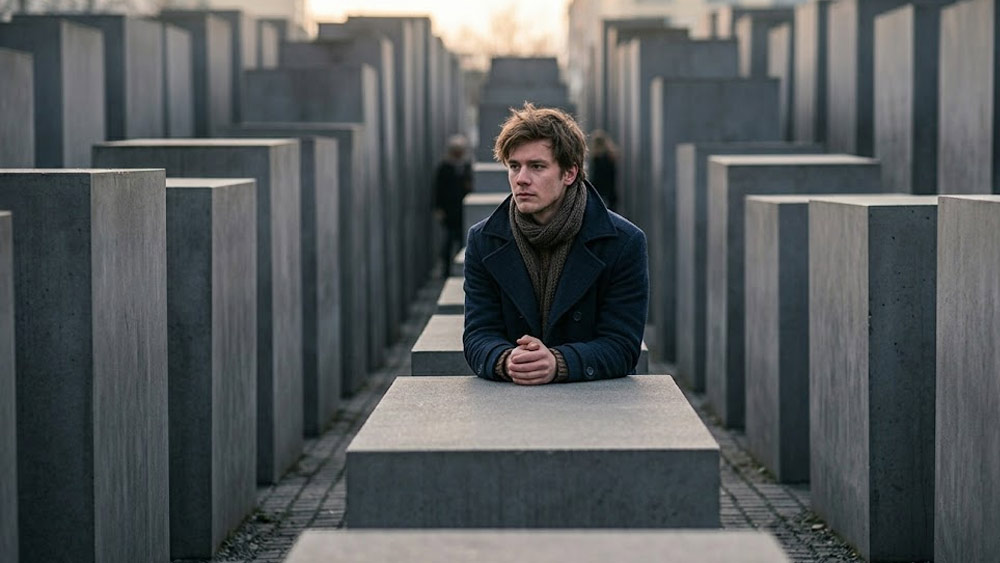
The Israeli dissonance
And then comes the local paradox.
On one hand: a strong המדינה, a military, independence, כוח.
On the other: one day a year when everything collapses back to zero.
This creates tension.
Because Israeli identity is built around strength, initiative, control.
And Holocaust Remembrance Day forces a confrontation with the exact opposite.
It is uncomfortable.
At times, it even feels like a betrayal of the narrative we construct for ourselves throughout the rest of the year.
So why is it stronger?
Because Holocaust Remembrance Day offers no resolution.
There is no “and then we rose.”
No “and since then, we are here.”
No real catharsis.
It ends without closure.
Memorial Day, despite its pain, does provide a form of closure.
There is continuity. There is context. There is a present that carries the past forward.
Holocaust Remembrance Day remains open.
And the human mind does not handle open endings well.
The simple truth
Perhaps, in the end, it is simpler than all of this.
Perhaps it has nothing to do with family history.
Nothing to do with personal narrative.
Perhaps it is simply this:
I am a Jew.
Not in a religious sense.
In a raw, unfiltered sense of identity.
Holocaust Remembrance Day strips everything else away and leaves only that.
No filters.
No ideology.
No politics.
Just identity.
Conclusion
It is not a paradox that this day breaks me more.
It is, in fact, entirely logical.
Because Holocaust Remembrance Day touches a place that has no defenses:
No army.
No state.
No story of heroism.
Only a human being,
confronting the full capacity of the world to dismantle him.
And perhaps that is why those of us who did not experience it directly – who did not grow up with stories from within it – sometimes feel it even more intensely.
Because for us, it is not mediated by personal memory.
It arrives unfiltered.
Without softening.
Without distance.
And it hits exactly where language fails.
הירשמו כדי לקבל את הפוסטים האחרונים אל המייל שלכם
Discover more from Intelligent is sexy
הירשמו כדי לקבל את הפוסטים האחרונים אל המייל שלכם