Gunfire at Arab Weddings in Israel – When the Reception Comes with Live Ammunition

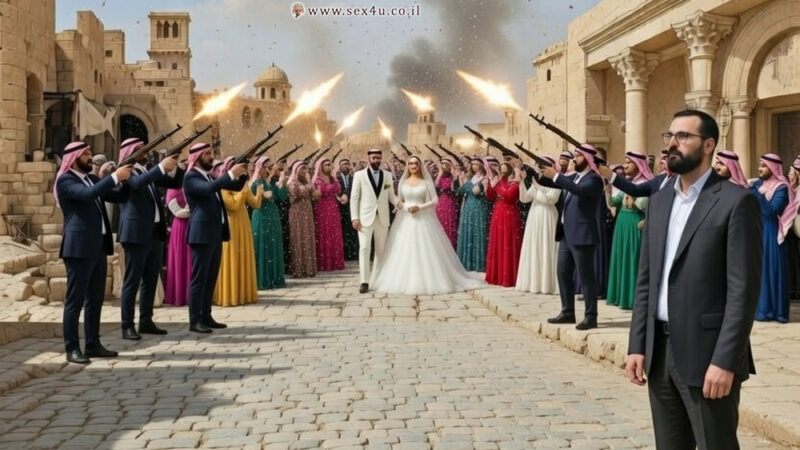
Not a “Custom,” but a Persistent Social Failure
In Israel 2026, you don’t need to wait for a war to hear gunfire.
You just need wedding season.


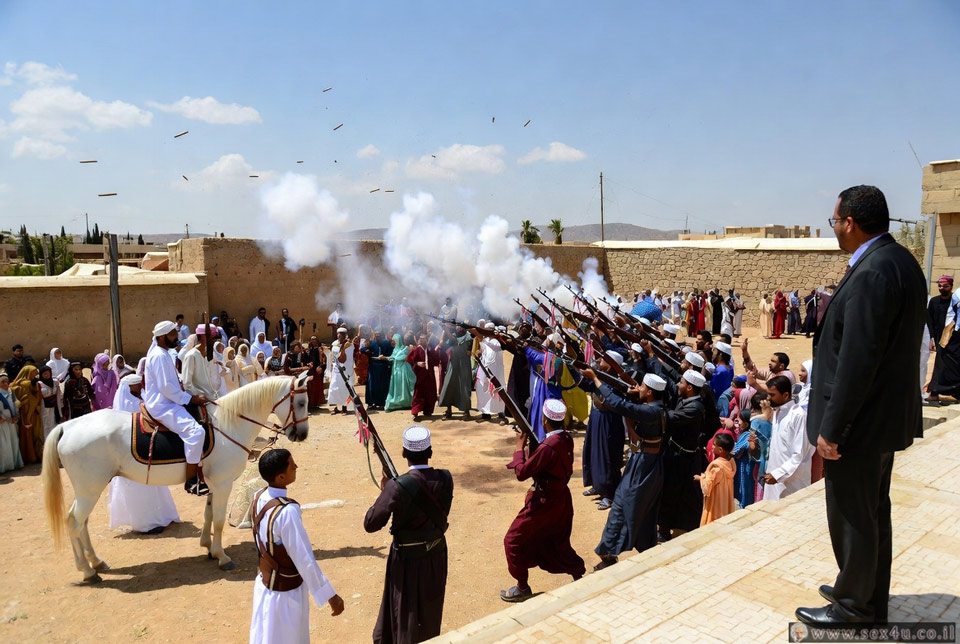
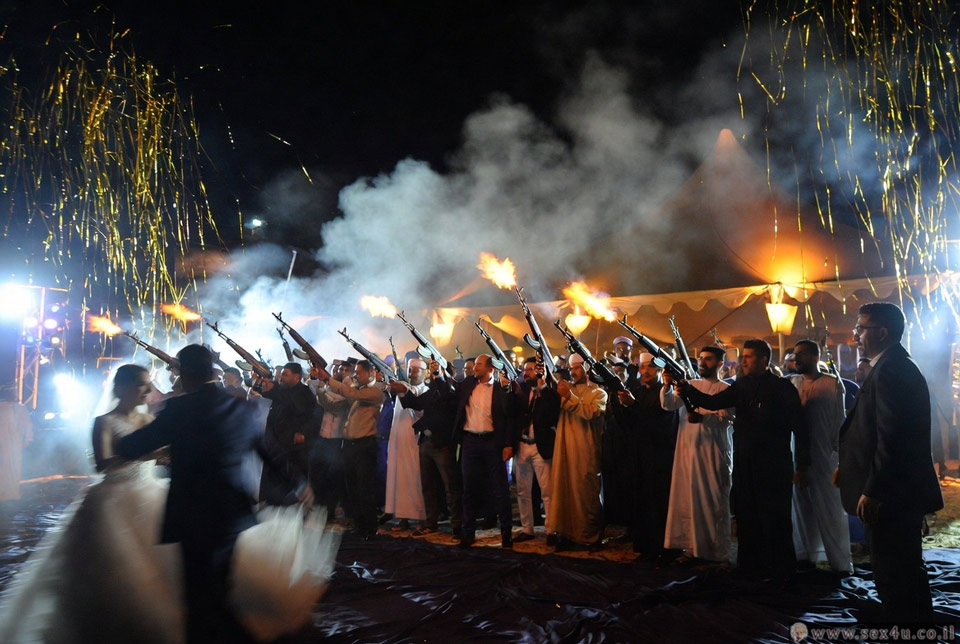
The pattern is familiar, documented, filmed, investigated – and still recurring: a wedding in an Arab town, loud music, a convoy of cars, and then – gunfire into the air. Sometimes dozens of rounds. Sometimes hundreds. Sometimes injuries. Occasionally deaths.
You can keep calling it “celebratory gunfire.”
But after years of stray bullets and random victims, the phrase sounds less like tradition and more like a bad inside joke.
Let’s Talk Facts – No Sugarcoating
Wedding gunfire is not a nationwide Israeli phenomenon.
It is concentrated almost entirely in Arab localities. That is not a stereotype. It is police data.
The real question is not whether it happens, but why it keeps happening – and how an unmistakably criminal act became, in certain places, part of the accepted wedding scenery.
This is where patience for slogans runs out.
It is not “folklore.” It is live ammunition.
It is not “heritage.” It is a dangerous criminal offense.
And it is not “lack of awareness.” Everyone knows that a bullet fired upward eventually comes down – sometimes into someone’s lungs.
Not Culture – The Normalization of Power
It is easy to say, “That’s their culture.” It is also lazy. It explains everything by explaining nothing.
Culture is not a force of nature. Culture is a system of norms. And norms change.
When gunfire at a wedding is met with applause rather than outrage, that is not destiny. It is a social choice.
And that choice rests on three clear foundations:
1. Massive Presence of Illegal Weapons
Tens of thousands of illegal firearms circulate within Arab society in Israel. This is no longer a secret. It is a market.
2. Years of Weak Enforcement
The state reacted late. Long periods of hesitant policing, fragmented governance, and reluctance to confront organized crime created a vacuum.
3. Quiet Internal Legitimacy
Even if not everyone pulls the trigger, not enough people intervene. Not enough leaders stand up and say, clearly: this is not who we are.
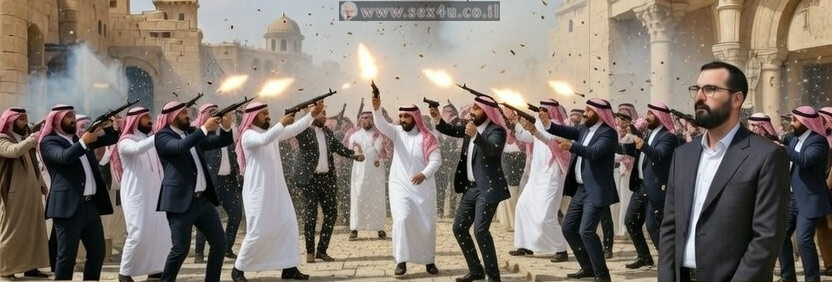
The Real Problem Is Not the Bullet – It’s the Indifference
What is truly alarming is not the sound of gunfire.
It is the endurance of the phenomenon.
How many panels have we watched?
How many “emergency programs” have been announced?
How many declarations about “fighting crime in the sector”?
And still, every year, the same headlines.
As long as firing a weapon in the middle of a wedding is perceived as a display of masculinity, status, and control – it will continue.
This is not about ethnicity.
It is about norms surrounding violence, honor, and power.
Let’s be honest: when a young man stands in the center of a dance floor with an M16 and receives cheers, that is not folklore. It is a performance of dominance. And the crowd applauds.
The State Has Responsibility – But Not Exclusivity
The phenomenon cannot be detached from the broader context of organized crime within parts of Arab society: extortion networks, protection rackets, targeted killings, local crime families.
The weapon that “celebrates” at a wedding is often the same weapon used in a nighttime assassination.
It does not materialize from nowhere.
And it does not disappear on its own.
When a state projects years of weak control, someone else fills the void.
And when weapons are readily available, they eventually demand an audience.
The Uncomfortable Question
Can Arab society in Israel uproot this practice from within, decisively and publicly?
There are leaders who try. There are initiatives. There are courageous voices.
But so far, those voices have not been strong enough to overturn an entrenched norm.
And this is the heart of the issue:
Not an “inherently violent culture,” but a social environment in which a specific violent pattern has not been confronted forcefully enough.
This is harsh criticism.
But it is aimed at behavior and leadership – not identity.
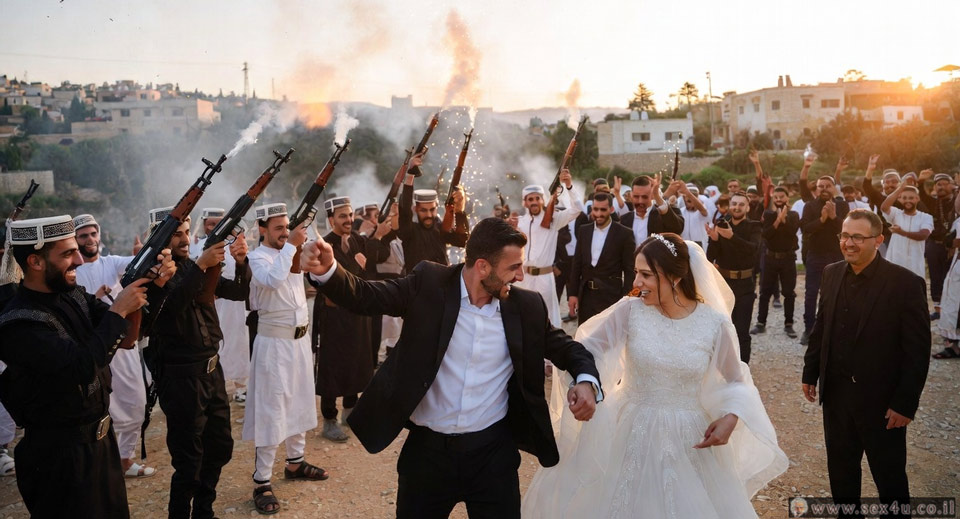
A Failure of Leadership Before It Is a Failure of the State
Blame the government.
Debate governance.
Discuss illegal weapons and smuggling routes and budgets.
All legitimate.
But before anything else, it must be said plainly:
Wedding gunfire in Arab towns is first and foremost a failure of local social and political leadership.
Not of ancient tradition.
Not of fate.
Of leadership.
Silence Is Not Neutral
A wedding is meticulously planned: DJ, catering, photographer, venue. Every detail choreographed.
Yet when someone pulls out a weapon and fires into the air, the reaction is rarely collective shock. Sometimes it is encouragement.
That is the problem.
Not because everyone supports it.
But because too many are willing to tolerate it.
A municipal leader who avoids launching a firm public campaign.
An imam who does not dedicate a clear sermon against it.
Prominent families that do not state unequivocally: not at our events.
Silence is not neutrality.
It sustains the norm.
Imagined Honor, Real Fear
In many cases, the gunfire is not merely “celebration.”
It is a declaration:
We have weapons.
We have status.
We are not afraid.
But behind the display often lies something else entirely: fear.
Fear of confronting armed young men.
Fear of being labeled the one who “kills the vibe.”
Fear of standing up to powerful clans or criminal actors.
When leadership operates from fear, society pays the price.
There Is No Vacuum – Only Choice
Every society has destructive behaviors.
The question is whether they are granted quiet legitimacy.
If automatic gunfire erupted at a Jewish wedding, the event would likely halt immediately, police would intervene, and the community would condemn it.
Not because of different genes – but because of different norms.
Norms do not emerge spontaneously. They are socially enforced.
When no clear social pressure is applied against the shooter, he becomes a temporary hero.
When there is no social cost, only the criminal one remains – and weak enforcement rarely deters.
The Responsibility of the Local Elite
Not everything is in the state’s hands.
A significant share lies with:
- Mayors and council heads
- School principals
- Religious leaders
- Business owners
- Clan elders
The same figures who mobilize communities to build roads or open community centers can mobilize them to shift norms.
Where is the large-scale campaign declaring: “Gunfire at weddings is a disgrace”?
Where is the social boycott of families that allow it?
Where is the collective commitment by event halls to cancel celebrations where shots are fired?
When none of this materializes, it is difficult to believe the issue is incapacity.
It looks more like reluctance.
“Don’t Stigmatize Us” – Then Eliminate the Stigma
A common complaint is that media coverage stigmatizes an entire community. And yes, sweeping generalizations are harmful.
But the way to stop stigma is not by attacking the messenger.
It is by removing the phenomenon.
A society that responds quickly, sharply, and with zero tolerance reshapes its own image.
The issue is not who reports it.
The issue is what happens on the ground.
Criticism Without Racism, Responsibility Without Excuses
Let this be clear:
Most Arab citizens in Israel do not fire weapons at weddings.
Most do not want their children growing up around guns.
But an armed and assertive minority manages to dictate reality – because the silent majority has not organized forcefully enough to stop it.
That is a question of leadership.
Of education.
Of boundaries.
Coexistence – Since We’re Here Anyway
Israelis love to talk about coexistence.
They are less enthusiastic about stray bullets.
Wedding gunfire is not a national symbol.
It is not destiny.
It is not DNA.
It is a norm that was created – and therefore can be dismantled.
It is the product of illegal weapons, weak enforcement, and tolerated displays of power.
If it is not confronted seriously – without festive press conferences and recycled slogans – the headline “Gunfire at Wedding” will remain a recurring entry in the national calendar.
Someone will have to pay a political and social price to change the rules.
Someone will have to stand in the middle of the dance floor and say: enough.
Until that happens, the bullets will keep rising into the sky – and local leadership will keep looking upward, hoping they do not fall too close.
Not because it is anyone’s essence.
But because it is a norm that has not yet been broken.
הירשמו כדי לקבל את הפוסטים האחרונים אל המייל שלכם
Discover more from Intelligent is sexy
הירשמו כדי לקבל את הפוסטים האחרונים אל המייל שלכם