
Peace: A Two-Sided Deal or a Monopoly of Power?

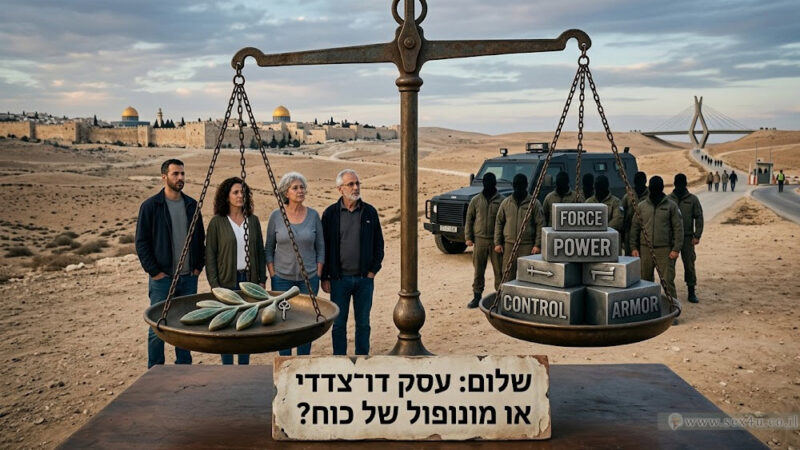
Do You Need Two for Tango – or Just One Side with Heavier Boots
There are phrases that sound so good
no one bothers to check if they’re true.


“Peace is made with enemies.”
“It takes two sides.”
“There’s no military solution.”
Elegant.
Balanced.
Perfect for headlines.
There’s just one small issue:
reality never signed those agreements.
The Romantic Version: Two Sides, One Outcome
Let’s start with the nice version.
Two peoples.
Two narratives.
Two sets of pain.
They sit, talk, compromise-
and reach peace.
It sounds like the end of a film.
Music.
Speeches.
Applause.
Except real life
doesn’t come with a soundtrack.
It comes with interests.
With power.
With history that doesn’t forget.
And sometimes-
with one side that simply isn’t interested.
Reality Check: Not Every Side Wants Peace
This might be the least popular sentence in the debate.
But someone has to say it:
Not every conflict is between two sides seeking the same outcome.
Sometimes one side wants an agreement.
The other wants victory.
Not compromise.
Not coexistence.
Victory.
And when that’s the case,
asking “why is there no peace?”
becomes slightly… naïve.
Power: The Only Universally Understood Language
There is an uncomfortable truth in history.
Peace doesn’t always emerge from dialogue.
Sometimes it emerges from power.
Not power for its own sake-
but power that creates boundaries.
That sets a price.
That draws red lines.
Because in the end,
the other side is doing the math.
If the cost becomes too high-
it reconsiders.
And suddenly,
peace becomes an option.
Not because it became morally appealing-
but because it became practical.
Israel: Between Ideology and Reality
In Israel, this debate isn’t theoretical.
It’s daily life.
There are those who believe
that if we just want peace enough-
it will come.
That we must “extend a hand,”
“initiate,”
“show goodwill.”
And then there are those who look around
and ask a simple question:
To whom?
Because goodwill is not a strategy.
It’s an addition.
And it only works
when there is someone on the other side
who wants it too.
The Problem with “Only Power”
But let’s not get carried away.
The opposite argument isn’t perfect either.
Saying “only power brings peace”
is like saying a hammer solves everything.
Sometimes it works.
But not everything is a nail.
Power can create deterrence.
It can create quiet.
But quiet is not always peace.
Sometimes it’s just a pause.
Peace – or a Ceasefire with Good PR?
Here comes the real trick.
We like to call things “peace”
even when they’re not.
Temporary arrangements.
Fragile understandings.
Carefully balanced tensions.
That’s not peace.
That’s conflict management.
And that’s fine.
But it should be called what it is.
Because when you label a ceasefire “peace,”
you’re surprised when it ends.
The Western Illusion
The Western world prefers clean solutions.
Dialogue.
Inclusion.
Mediation.
And it works-
when both sides play by the same rules.
But when one side plays chess
and the other plays survival-
things get complicated.
Very.
So What’s the Truth?
As usual, the truth isn’t comfortable.
Real peace requires two sides.
But getting there
is not always symmetrical.
Sometimes you need strength-
to create the conditions where dialogue is even possible.
Sometimes you need initiative-
to seize an opportunity.
And sometimes-
there’s no one to talk to.
That’s the possibility people dislike the most.
The Israeli Mindset: Between Hope and Realism
The average Israeli lives between two poles:
On one hand-
a desire for peace.
Because who doesn’t want it?
On the other-
a refusal to commit suicide for it.
Which creates an interesting balance:
Aspiration-
with built-in skepticism.
Willingness-
with brakes.
It may look contradictory.
It’s actually experience.
Conclusion: Not a Tango – More Like a Fight with Pauses
So do you need two sides for peace?
Yes.
But you don’t always need two sides
to reach the point where peace becomes possible.
Sometimes,
one strong side
creates that reality.
Not because it’s morally superior-
but because it defines the conditions.
It’s not romantic.
It’s not pretty.
But it’s real.
And in the Middle East,
like in the Middle East-
reality doesn’t aim to be comfortable.
Only relevant.
And the real question isn’t just
how to make peace.
It’s
with whom.
הירשמו כדי לקבל את הפוסטים האחרונים אל המייל שלכם
Discover more from Intelligent is sexy
הירשמו כדי לקבל את הפוסטים האחרונים אל המייל שלכם